
Back to 6 May | Head of Planning and Control FMG Marieke van den Bergh: “A need for an accessible way to reconnect”

Last week marked exactly one year since the pro-Palestinian protests at the UvA got completely out of hand. In this series, Folia talks to various people involved about their experiences. Today part 6: Head of Planning and Control FMG Marieke van den Bergh. In the aftermath, she decided to put a positive spin on the situation.

“When the protests began on 6 May, I was at the faculty office. I noticed that there was a commotion and that people were starting to walk around restlessly. I tried to remain calm and continue with what we were doing. I didn't want to create more unrest by acting like a disaster tourist. I didn't immediately think it would turn into a huge mess, but when I saw pallets appearing on the field at one point, I did start to worry a bit more. It was particularly difficult that the activists and the UvA didn't seem to be able to communicate with each other. There were a lot of intense emotions, of course, and neither side was really able to engage in meaningful dialogue.”
Discouraged
“Things escalated a week later, on 13 May, when Roeterseiland was invaded and the faculty office was vandalised and destroyed. Again, I tried to keep calm and react in a measured way, but when security came to tell us to pack up our things, I left immediately. When I saw the images of the destruction and the smashed screens at home, I found it very disturbing. I felt discouraged and wondered how we would ever get out of this. Everyone was becoming increasingly frustrated and felt powerless.”
“I think what is happening in Gaza right now is terrible, so I understand the impatience of the younger generation very well. They feel so much dedication, passion and ambition to improve this conflict, but they also face powerlessness. That is sometimes difficult to accept. I think that is where the anger comes from, and I understand that frustration very well. Nevertheless, there was an atmosphere of fear among colleagues during those days. The day after the occupation, we had a Zoom meeting to discuss the whole incident. I was extremely sad and cried during that conversation. How were we ever going to function normally again?”
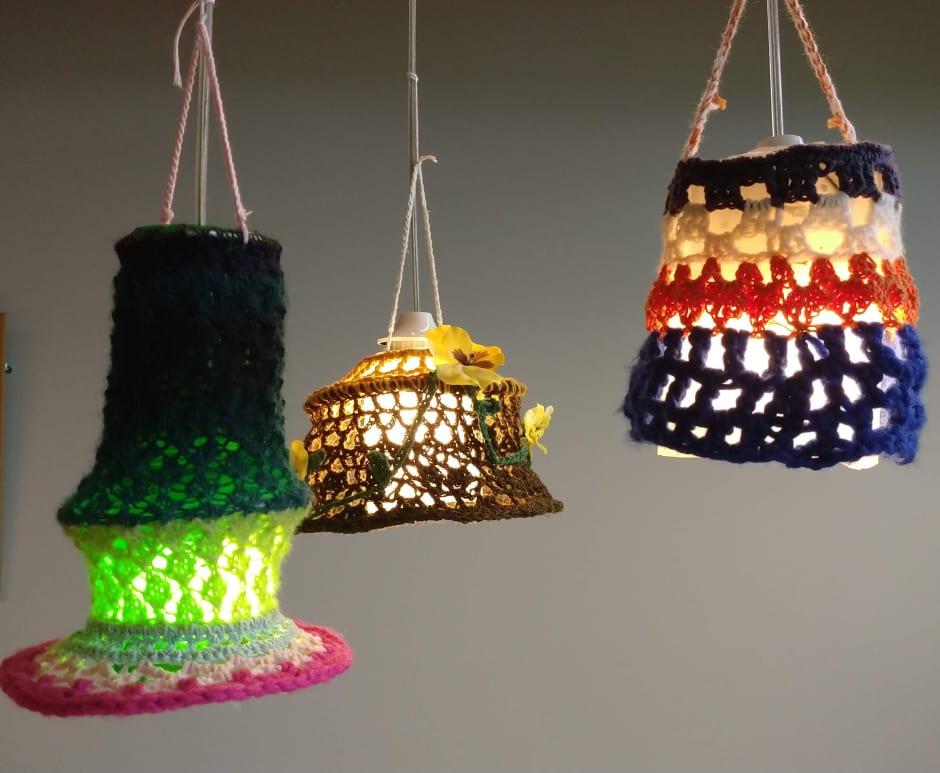
Lampshades
“Later, when most of the office had been repaired, everything seemed peaceful again. Still, you could sense that feelings of fear and insecurity lingered. Six bare light bulbs were still hanging in the faculty office, which I felt symbolised that something had indeed changed. I still had a crocheted Saint Martin's lantern at home, so I hung it over one of the light bulbs as a lampshade. I had some wool left over, so I decided to make more. It became a kind of small art project, where I asked colleagues to donate leftover wool, which I used to make lampshades. In the end, we had six unique lampshades.”
“It may sound a bit corny, but I really believe in the power of art. You can write policy memos, but sometimes a song is much more effective. In any case, it worked for me, and I noticed that the new lampshades sparked conversations. It's a completely irrelevant topic, of course, but it turned out to be an accessible way to reconnect a little, which was apparently needed.”