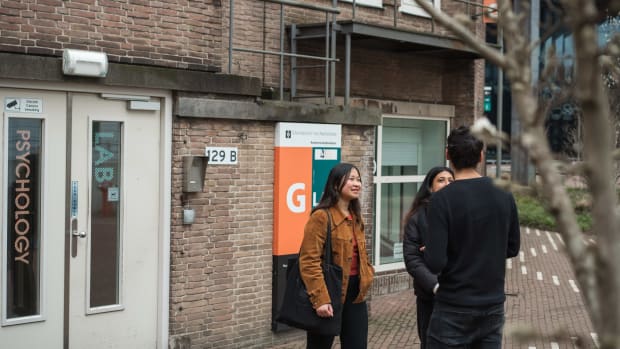
What is the benefit for the Netherlands of an English psychology programme?

On Tuesday afternoon, the University of Amsterdam announced its intention to end its English bachelor’s programme in psychology as part of a joint “sacrifice” by Dutch universities to get the language test (TAO) scrapped. The decision was not well received, but why do we actually train English-speaking psychologists in the Netherlands?
If it were up to party leader Pieter Omtzigt (NSC), English-language psychology programmes would already have been abolished in the Netherlands. He sees little point in English-language programmes that attract many international students because, he says on X, “you really need to speak Dutch if you want to be a psychologist here”.
He is not alone. According to psychologists at the UvA, there is a “negative sentiment about psychologists” within the government. And it’s not just in politics; NWO chairman Marcel Levi has also wondered aloud what the point is of English-language psychology programmes in the Netherlands.
On Tuesday, the UvA announced its intention to abolish its English-language bachelor’s programme in psychology in an attempt to get the language test (TAO) scrapped. Education Minister Eppo Bruins wants to assess all English-language programmes in the Netherlands to determine whether the use of English is necessary, and universities fear that many English-language programmes will then be discontinued. That is why the universities, through the umbrella organisation Universities of the Netherlands (UNL), took matters into their own hands last week and came up with a package of measures to reduce internationalisation as an alternative to the TAO. The abolition of the Bachelor’s programme in Psychology at the UvA is part of this.
According to Merel Kind, professor of clinical psychology at the UvA and chair of the psychology department, this view is based on a misunderstanding. “First of all, we are not a vocational programme. We do not – as Omtzigt thinks – only train students to become therapists. We train students in science. Sixty percent of bachelor’s students choose a clinical specialisation, half of our bachelor’s students go on to do a master’s degree. Of all master’s students, and of those, thirty percent choose a clinical master’s degree. What’s more, the clinical programme is already taught exclusively in Dutch.” Incidentally, the clinical master’s programme is also an academic programme and not a training programme to become a therapist. Professional training to become a psychotherapist is a postgraduate programme.
Champions Leage
According to Kindt, a large proportion of psychology students end up in business, where English has been the lingua franca for years. “Our students work for the government, the police, the armed forces, national counter-terrorism agencies or as data scientists in AI. Dutch students also choose the English-language track to increase their chances on the job market.”
“Take Unilever, Philips or ASML,” Kindt continues, “English has long been the working language there. Even at sports clubs such as Ajax, English is spoken in the changing rooms. The proposal to scrap the English-language bachelor’s programme in psychology is like saying to Ajax: you’re all going to speak Dutch, so we won’t be taking any more international footballers. Then you’re no longer in the Champions League.”


According to Kindt, it is precisely the use of the English language that makes psychology programmes in the Netherlands among the best in the world. “Germany and France have been lagging behind in psychology for a long time, and that’s because they were late in making the switch to English.”
Figures
One of the arguments put forward by the Universities of the Netherlands (UNL) to justify scrapping English-language psychology programmes in the Randstad is that the retention rate of international psychology students in the Netherlands is relatively low. Kindt: “We don’t know where they got those figures from. Are politicians coming up with these numbers and the UNL is just repeating them? All we know is that many German students who study in border regions such as Maastricht return to Germany after graduating to look for work there.” It is precisely in the border regions that the English-language bachelor’s programme in psychology will continue to exist.
According to the UNL, the figures come from the ROA, a research institute of Maastricht University for education and the labour market. These figures show that only 25 per cent of students from the European Economic Area (EEA) (the vast majority of international students in the Netherlands) remain in the Netherlands after completing their master’s degree in psychology. “Only law has a lower retention rate, but that concerns a small group,” according to the UNL spokesperson.
The ROA figures also show that the labour market prospects for psychology are less favourable due to the large number of graduates. According to UNL, only business administration programmes show a larger surplus of graduates and expected job openings.
Resistance
For the time being, the plan of the Dutch universities is only a proposal. Education Minister Bruins can reject the plan and still decide to implement the TAO. Omtzigt has already stated via X that the proposal still allows for too many international bachelor’s students: “A decrease from 19,000 to 17,000 enrolments per year is not enough.”
If the TAO is implemented, it is unlikely that the English-language bachelor’s programme in psychology at the UvA will continue to exist. Nevertheless, the psychology department hopes that Bruins will reject the proposal currently on the table. Kindt: “We expect that if so many programmes are at risk with the TAO, resistance at universities will increase. And that the UNL will stand its ground. If necessary, this means that universities will temporarily close their doors and suspend teaching until the proposal is withdrawn.”
Kindt is already in conversation with other psychology programmes in the Netherlands, she mentions Leiden, Rotterdam, VU Amsterdam and Utrecht. “The abolition of English-language tracks will lead to massive reorganisations in all programmes in the Netherlands. We currently have 550 first-year students, half of whom are Dutch. Before we started offering English-language programmes, the Dutch intake was 350. So we suddenly have a surplus of places, and students will spread out differently across the Netherlands.’