To manage stress, dean Marieke de Goede swims in an ice-cold dune lake

To keep her job stress at bay, Marieke de Goede, dean of the Faculty of Humanities, does cold-water swimming twice a week. “In the winter cold here, your body really goes into survival mode. Then all your thoughts fade.”

At most, it is ten degrees. Crossing the bleak dunes of the North Holland coast, rain starts pouring down from the sky. Dean Marieke de Goede (53), in her wetsuit, looks somewhat reluctantly at the water. The small dune lake looks more like an ice-cold bubble bath. But today she will swim in this icy pool, although “I have to cross a threshold every time anyway”.
Every two weeks, the dean dives, usually with her husband, into one of the dune lakes west of Amsterdam. Swimming in icy water is something De Goede, an experienced swimmer, and her partner have been doing for about four years now. At corona time, instead of swimming only during the regular seasons, the couple decided to continue swimming in winter as well. “And slowly we were able to stay in the ice water for longer and longer.”
Coots and dragonflies
Shivering, De Goede waded up to her knees through the shallow shore of the icy lake. She can be found in the small lake both in summer, more for exercise, and thus into the deep winter days. “In the winter cold, your body really goes into survival mode here. Then all your thoughts go out.” Her enthusiastic partner, meanwhile, sprints into the water in just his swimming trunks. The two swans present float towards him seemingly amazed, but he is back on the shore after only a few minutes. “Everyone has their own way of being in the water,” the dean explains.
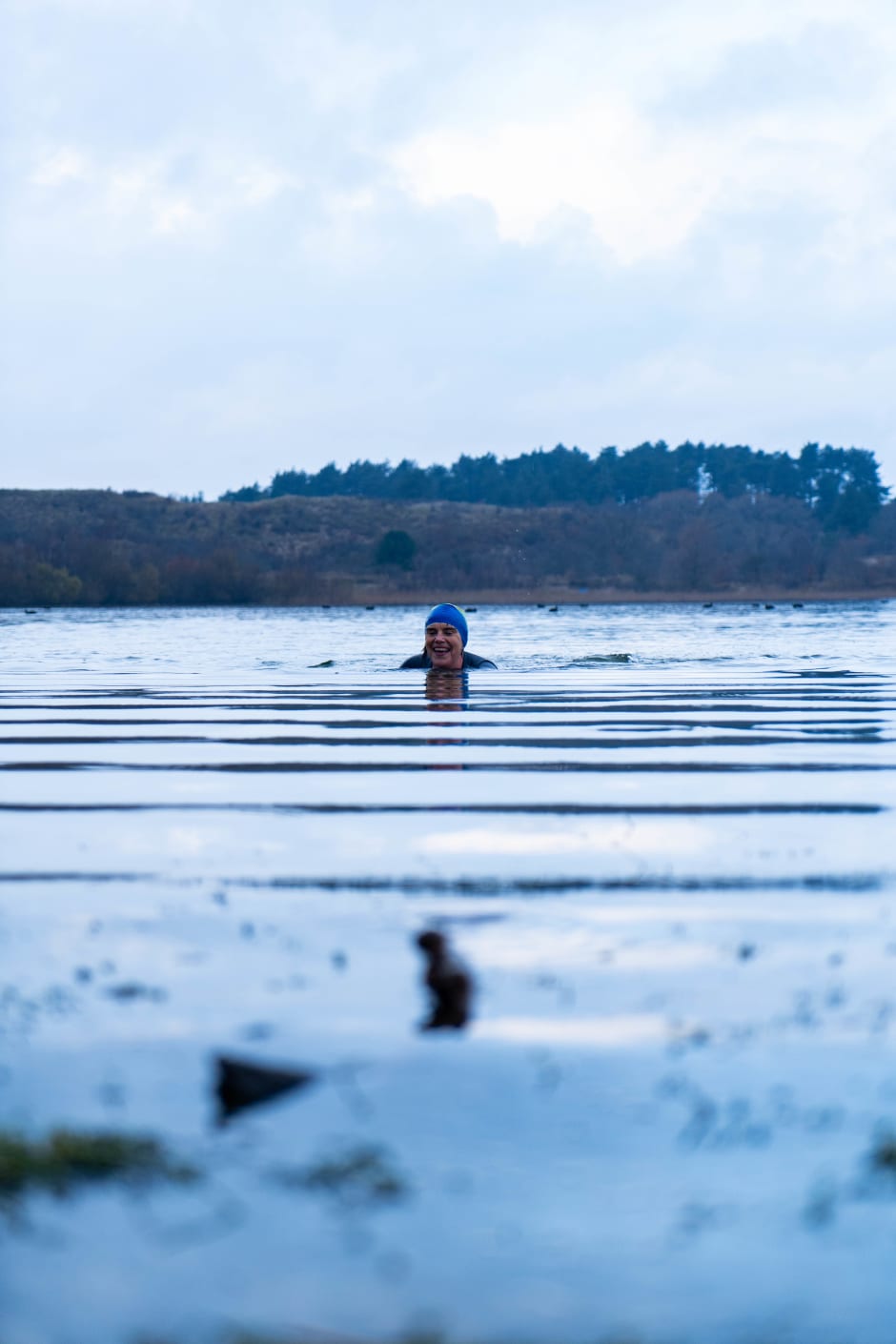
De Goede also gathers her courage and dives headfirst into the ice water. With a smooth chest crawl, she moves between dozens of undisturbed coots. “You are right in the middle of nature here.” A few birds croak after the swimmer as she swims away from the shore. “Then, for example, it is also beautiful to see seasons change: coots in winter, dragonflies in summer.” And wildlife management has nothing against wildlife swimmers, as long as they keep their swimwear on.
Among the ice
The dean’s head disappears from view as she approaches the other side of the dune lake almost two hundred meters away. She does not have a specific way to breathe in the icy lake. “Just breathe through.” De Goede does not use Wim Hof-like breathing or other meditation techniques. “My body is used to the temperature with the seasons.”
She does, however, avoid swimming in the deep parts of the lake far into winter for safety’s sake. “When I was here among the floating ice, I once had the experience that I got really too cold in my swimming costume. I spent the whole day shivering uncontrollably. Now I have a wetsuit.”
“Your body has a shock reflex to extreme cold. Your blood vessels to your skin constrict so that especially the vital parts of your body can stay sufficiently warm,” says Professor of Physiology Jan Hindrik Ravesloot. “Your body is working so hard that for a while you can’t think about that argument with your mother or the pressure on your studies. Your metabolism drops and you have to breathe more deeply and calmly, almost meditatively.”
“Moreover, all kinds of positive hormones are released when you come out of the cold afterwards and you are rewarded with a rosy feeling. That’s your blood vessels reopening and all your muscles being able to relax again.”
“You can swim in cold water just fine, as long as you have a healthy body and build it up slowly. Of course, your body can become hypothermic and numb if the blood can no longer reach vital parts sufficiently. Therefore, it is good to keep swimming to stay warm. If you start shivering uncontrollably, you should make sure you get out of the water as soon as possible.”
Work pressure
De Goede turns around in high concentration and starts the long way back. As her strokes seem to get heavier and heavier, walkers, runners and an occasional forest ranger watch from the dune hill. For De Goede, however, this is the way to throw off the stress of her job. “As dean, I am very busy right now. But that is actually true for everyone, the workload is high. The academic world can be very hectic, even really competitive.”
De Goede therefore advises colleagues to find their own way of relaxing for a while. “That could be anything, but if you feel you don’t have the time to do something like that, you should do it right.” Because after a refreshing dip, De Goede knows one thing for sure: “Afterwards, you are much better able to discern what is important again.”
Shuddering, the professor appears at the water’s edge. Once out of the lake, De Goede feels spot on. “It is such a wonderful sensation when you come out of the water, in your body as well as in your head: alert and yet relaxed.” Excited, the dean walks back across the now cleared dunes. “I really need to do this twice a week to cope with my workload.” When she gets into her warm car dried up not much later, she turns towards the dunes. “It might be crazy, but I suddenly left all my worries at that lake.”