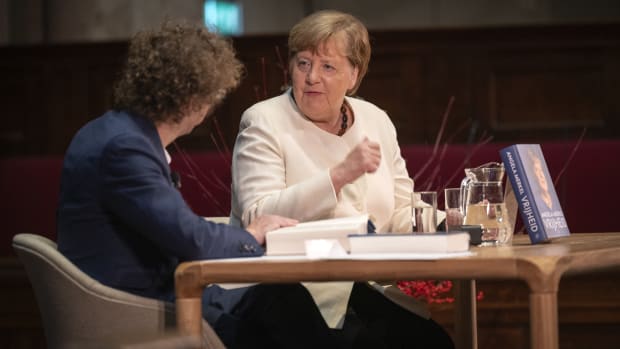
Angela Merkel in UvA Auditorium: “More money will have to go to defence, and fast”

Former German Chancellor Angela Merkel spoke last night in the UvA's auditorium with writer Arnon Grunberg about her recently published autobiography Freedom. Much came up, including anti-Semitism in her country. “If you are against Netanyahu's policy, you cannot say: that gives me the freedom to be against Jews.”
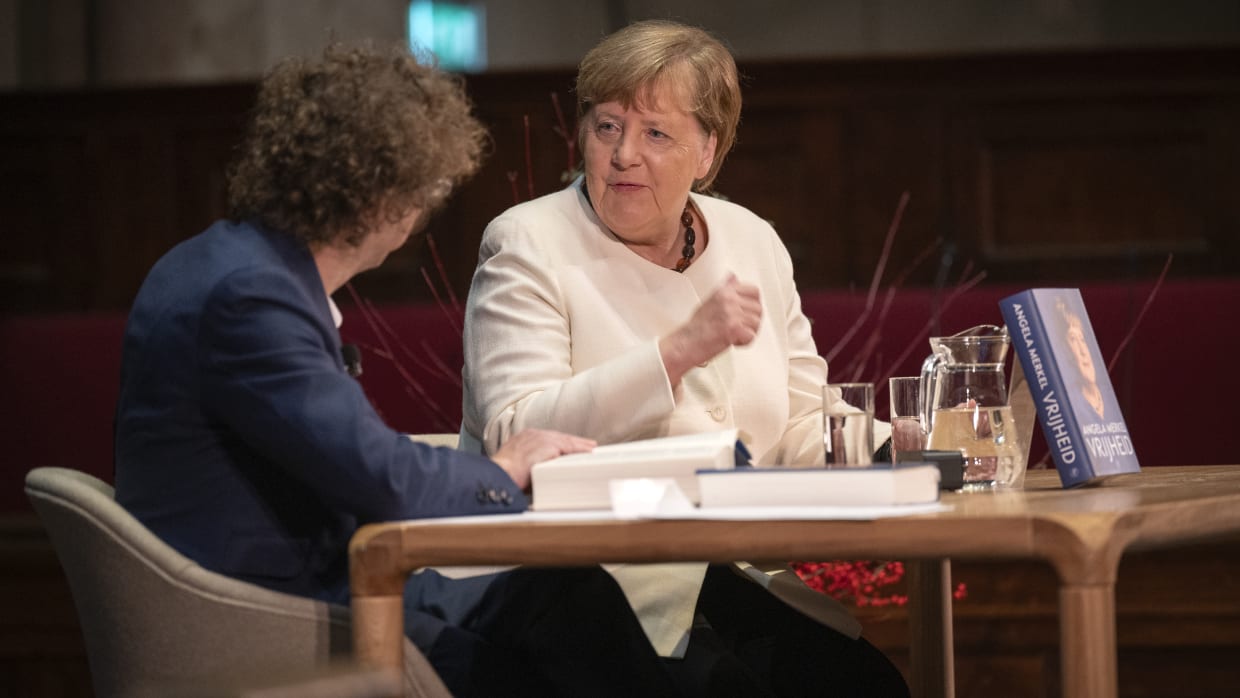
Although a march against the UvA administration also ended that day, the Spui in Amsterdam was largely dominated by former German Chancellor Angela Merkel's visit on Thursday. In the afternoon, she signed her recently published book Vrijheid. 700 pages of autobiography, in which she looks back on her life; for 16 years (2005-2021), the now 70-year-old Merkel tirelessly devoted her life to Germany.
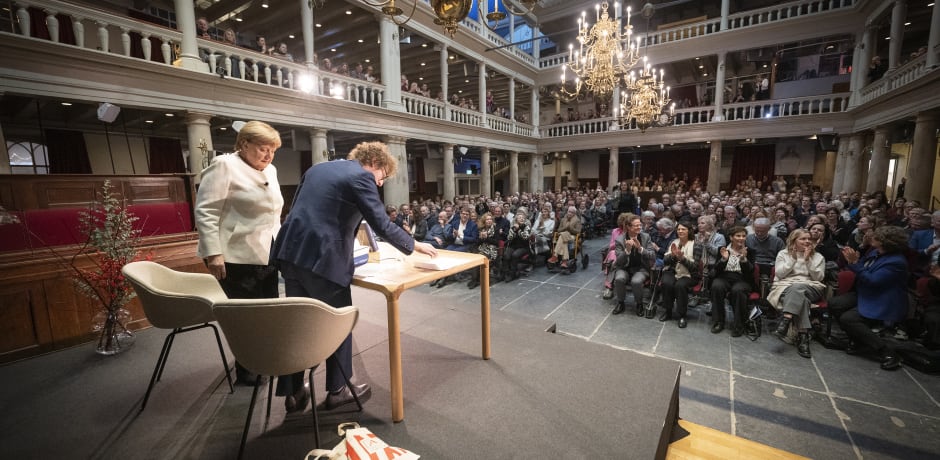
The queue of people wanting to get her autograph was long. In the evening, that wait was duplicated. Right opposite the bookshop, in the auditorium of the UvA, Merkel explained her autobiography in front of a sold-out audience from 20:30. So around the clock of eight, the Spui was once again full of people who had come for Merkel. Shortly before, the Altkanzlerin had received from the hands of Mayor Halsema the Golden Medal of the City of Amsterdam, the highest award the city can give.
The evening in the Aula was organised by Spui25, the academic-cultural podium affiliated with the UvA, and was led by writer and presenter Arnon Grunberg. On a raised stage, he spoke in German with Merkel about her choices as Chancellor. Much passed by in a relatively short space of an hour and a half.
Refugee intake
Take the still existing (electoral) differences between (former) East and West Germany and her youth in the GDR. “Living in a dictatorship is also a life,” says Merkel, who usually notices a lot of misunderstanding about that. “We also had friends, also experiences, also parents, and also went on holidays.”
She also talked about how she received the scorn of the Greeks at the time of the euro crisis. “I don't want to compare Greece to the GDR, but the fact is that they had not reformed sufficiently. Incidentally, my Dutch colleague Jan-Peter Balkenende supported me in that, with whom I worked well.” And about the deal with Turkey, which was supposed to ensure a smaller flow of refugees to Europe. “You defend that deal and call it pragmatic,’ Grunberg said, “but wasn't this the point where Realpolitik took the form of cynicism?” He pointed to the human rights violations that have taken place in Turkey under Erdogan and are contrary to EU norms and values.
On the contrary, Merkel thought. Cynicism, she said, is putting people in danger on the Mediterranean Sea without doing anything substantial about it. “Erdogan has taken in three million refugees. Realpolitik, of course, but we can thank Turkey for this,” she said. Although Merkel also said she was sorry not to know for sure whether that money for Turkey actually reached the refugees as agreed.
Threat from Russia
“Do you know who you mention most often in your book,” Grunberg asked interestedly shortly afterwards. “Putin. 138 times. Netanyahu you mention once, and in the context that you were on the verge of agreeing to disagree with him at one point,” Grunberg said. 'In the Israeli parliament, you talked about Germany's historical responsibility. But don’t you think that at the moment there is too much fanatic fighting in Germany to consider something as anti-Semitic that is not anti-Semitic?”
“In fact, I say: no,” Merkel responded. “Indeed, there is a lot of anti-Semitism in Germany. But of course, you are allowed to criticise Israel. Only the point is: if you are against Netanyahu's policy, you are not allowed to say: that gives me the freedom to be against Jews.”
A little later, it was not about her book, but about recent developments in the world. More concretely: about the alarming statement NATO chief Mark Rutte had made in Brussels a few hours earlier. According to him, given the threat from Russia, we in the West should mentally prepare for war. Merkel said she had not seen or read back his entire speech (yet), but made the point that it would be preventable with enough and credible deterrence. And she couldn't agree more. More money will have to go to defence, she said, “and quickly”, Merkel said.
Donald Trump
This is all the more urgent now that Europe no longer seems to be able to count on the unconditional support of the US, where Donald Trump will once again take the sceptre, Grunberg suggested in the conversation. Merkel: “I believe that NATO is not only good for the Europeans.” It is in the Americans' own interest to stay in NATO, she said, “otherwise they are completely at their own mercy”.
Moreover, she seemed confident, albeit not in so many words, that this will remain the case under Trump. “Under his first presidency we had difficult conversations, but we always stayed together.” Although she did subsequently acknowledge that it was “not easy to talk about multilateral agreements with Trump.” “I think that's an understatement,” Grunberg replied.
At the end of the evening, attendees could again queue up to get their hands on a signed copy of Merkel’s autobiography, which was also on sale in the auditorium. Even in the evening, enough people were still eager to pay 45 euros for it.