New FMG dean Christa Boer: “Especially now we have to show society how valuable we are”
Since September, Christa Boer has been the new dean of the Faculty of Social and Behavioural Sciences (FMG). Not an easy time to start in times of cuts in higher education, the Internationalization in Balance Act (WIB) and the ongoing pro-Palestine demonstrations. How were her first few months? “I’m glad for me the glass is always half full.”

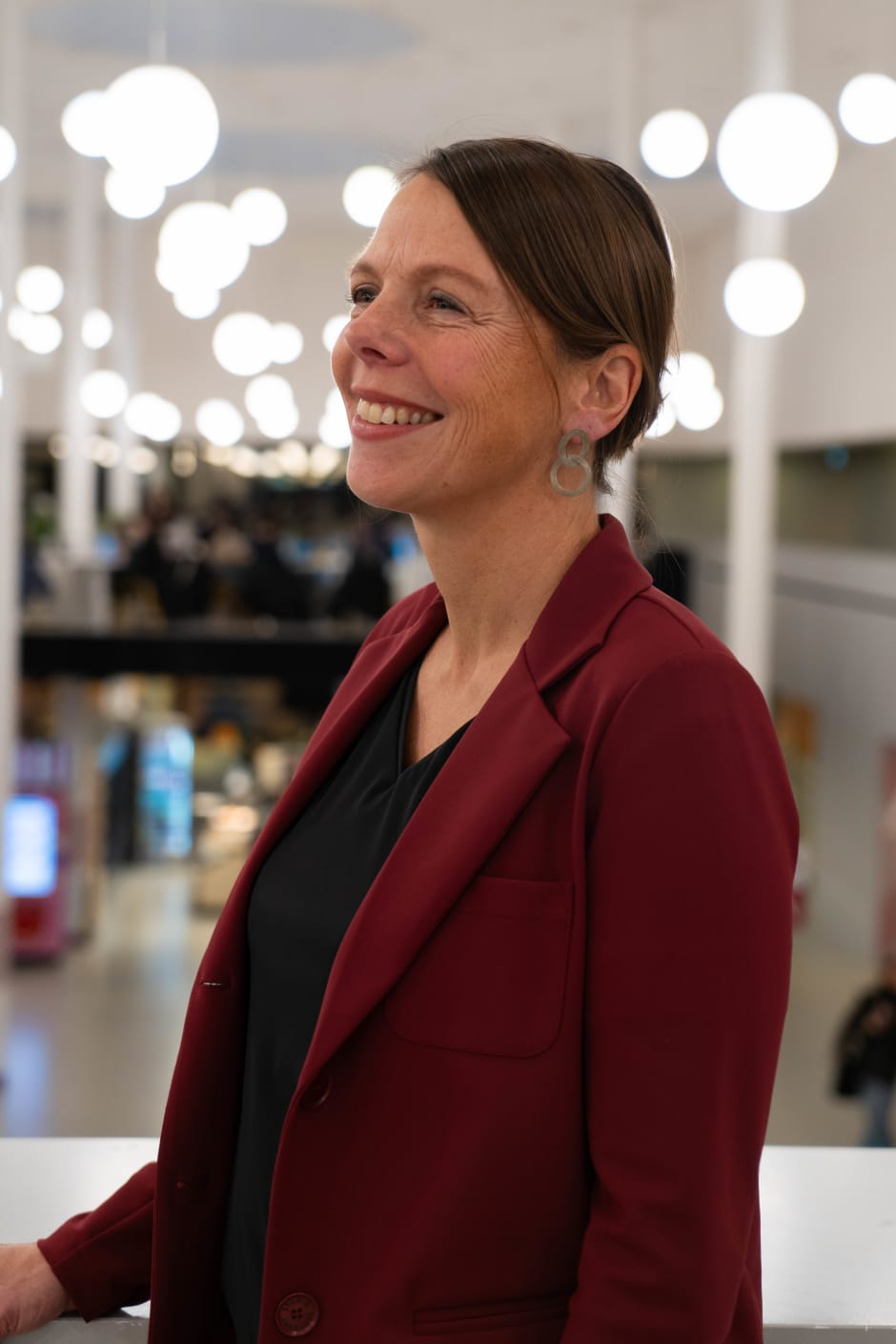
“Where do you want me for the photo?” Christa Boer opens the door to her office. A tidy room with a bookcase, desk and a vase of flowers on the table. On the wall hangs a large abstract painting. “That painting is still from Agneta,” she says, referring to the former dean Agneta Fischer. “I want to have something there that suits me.”
We descend to the first-floor balustrade as Boer shows us the way through a building she didn’t know a few months ago. “Exact science used to be taught here, and the classrooms were smaller. To create space, all the ceilings here were broken down.”
A conversation with Christa Boer is like a warm bath. “I like people very much, warmth and coziness.” Her head works well on complexity and chaos and is filled with small balloons with ideas about strategy and a ten-year plan. “But at the same time, I also love science and technology. And I keep my room tidy.”
Her husband, an instrument maker, managed to capture those qualities in a metal heart with radars that he made when they married. A heart that, when you rotate a screw, it turns into chaos, and then back into a heart. Prints of that heart Boer wants to hang in her office. “Funny isn’t it. The heart is like a marriage or a life.”
How were your first few months as dean?
“I found it very exciting to start here at both a new faculty and university, with a completely different culture. Could I build up the same familiarity here as I was used to at the VU? By now I can say that it succeeded, I feel very much at home here.”
“In terms of my personality I might also fit in better with the UvA. I like the decentralization, the chaos, the autonomy: saying what you think. In the medical world, everything is more hierarchical.”
What can your medical background add at the FMG?
“In my role as vice dean in medicine, I noticed that the transition of education to society fascinated me more and more. That’s where I can add value. I worked on eliminating the Cum Laude regulation in medicine, made the selection more diverse and reorganized the master’s degree without grades. I also made sure that “the white coat” was removed from the communication materials, because a doctor is not always a specialist in the hospital, fifty percent of doctors are working outside the hospital walls. I also worked on a social safety campaign with an app to report transgressive behavior. Those are all records with a connotation where you need certain skills, I take those with me.”
2024 - 2028 dean Faculty of Society and Behavior
2014 - 2018 professor of perioperative care, anesthesiology, VUmc
2002 - 2005 researcher and associate professor of physiology and anesthesiology, VUmc
1996 - 2001 PhD in physiology, VU Amsterdam
1990 - 1996 biomedical sciences, Leiden University
1971 born in Lisse, the Netherlands
With the cuts in higher education, the Internationalization in Balance Act (WIB) and the pro-Palestine demonstrations at the university, it is not an easy time to start as dean.
“I hear that often; someone even asked me, why are you even starting? At the same time, it suits me because I always see opportunities. Budget cuts sound very negative, and they are, especially when they affect people. But it also helps to make things clear. Last week, automaker Jaguar announced that they will only produce electric cars. That’s a disruptive message, of course, but it also creates opportunities. Given the cuts, let’s use it as well as we can.”
At the same time, the action groups demonstrating state that administrators should not take the cuts as a fait accompli.
“That’s also true. And I believe very much in education as a driving force for change. As a university, you can really contribute to major transitions in society. On the other hand: when there is scarcity you start looking at things differently and that is never a bad thing. It also creates creativity. Universities in the region have been suffering from a decline in students for quite a long time and have set up all kinds of initiatives for this. If you have known wealth for a very long time, you don’t have to think about that. You can look at it that way.”
At the same time, starter- and incentive grants are also being cut, making things harder for young researchers.
“Let me be clear: the cuts are obviously going to have a huge impact. I’m sitting here talking very cheerfully but that shouldn’t be the tone. But if this is all going to happen to us then you can’t start working on a plan only after it has already happened.”
“One of the first actions I initiated is to start a new strategy development for our faculty with an outside agency. That agency is going to develop scenarios for our faculty in 2035 based on input from researchers, faculty, doctoral students and people from outside the university. We are also in talks with the VU and Leiden University. I notice that working on a plan also gives energy. Especially in times of austerity, it is important to build a strong faculty with a clear message.”
And that message is?
“That FMG is important to society. Because I notice in the whole discussion about the budget cuts that that is not yet clear. With medicine, it’s super simple – everyone knows how indispensable doctors are in society. But does anyone in a village outside the Randstad ultimately know what communication scientists and political scientists do? I don’t think so. I can play a role in that as dean.”
“But I personally think the WIB is really a war zone. Our seven English-language programs are under threat, because of the Test of Foreign Language Education, and we don’t know what the outcome is going to be. I also think it has become a very narrow issue. It is mainly about numbers, while at the same time the WIB is also at the expense of education for Dutch students. In fact, our international tracks also attract many Dutch students. Students in communication science, for example, choose the international track precisely because they find it interesting to exchange ideas in an international context. They don’t think about that at all. We all say the EU is very important, while at the same time we limit internationalization, I find that quite hard to sell.”
Of all the cuts, what do you worry most about?
“Mainly about the impact it has on individual employees. In 2025 that impact will be limited, but what about after that? That uncertainty, that international colleagues feel unwelcome, that’s what I find most worrisome.”
“And also sad. How can I reassure international colleagues if I don’t know what the final picture will be? For me it is easy to say, I live in the polder close by, and I am Dutch. I worked abroad myself, and if you get such an anti-international message, I would find it very intense.”
Did you go to demonstrate against the cuts?
“Yes, on Malieveld. I must confess, it was my first demonstration. At the VU and the Amsterdam UMC you don’t see this kind of action that much.”
The students and teachers at FMG must be a lot more outspoken than at the Faculty of Medicine.
She hesitates for a moment. “Outspoken is not quite the word. It’s very important that people can make their voices heard. But it is an individual choice whether people join a demonstration or a strike. It’s about the space you give each other in that. At the Amsterdam UMC we also had nurses who went on strike, but that just happened. I can’t quite pinpoint it yet, but I do notice that there is a different dynamic here. Whether or not you join a strike or a demonstration is a topic of conversation here. And the message ‘Are you participating?’ is not neutral.”
Should the UvA stop its collaborations with Israeli research and educational institutions?
“If you always hear only one or two opinions on the dilemma and not the other ten, I find it very difficult to say anything about it. I want to give myself time for that and talk to people across the organization. These discussions didn’t happen overnight. With the most difficult dilemmas in my previous role, ultimately unraveling all that is involved was also a key to a solution.”
“But none of that can be done in three months.” She laughs. “We sit here and discuss very heavy topics right now, and this is just my introduction.”
But of course, you were warned that these issues are here.
“I think there are dilemmas in almost any sector in a position like mine right now. And if I can’t carry it, who should carry it? This is also what I came for.”
And was it good or bad that first few months?
“Well, I think I’m very happy that with me the glass is always half full. I always see a small bright spot somewhere. It’s going to be very important in the next few years that we show society how valuable we are. If I can do something in that, I think this job is already a success.”