Where do the Greek antiquities in the Allard Pierson Museum come from?
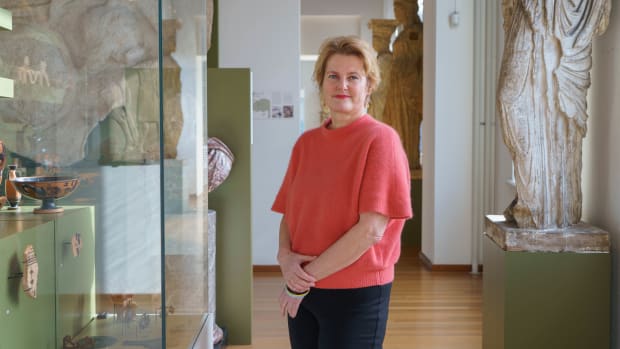
During her Fellowship, UvA archaeologist Anne Versloot delves into the world of controversial Greek art dealer Athanasios Rhousopoulos, whose merchandise is now part of the UvA the heritage collections. “His status as a professor gave his customers a sense of reliability, a scientific veneer.”
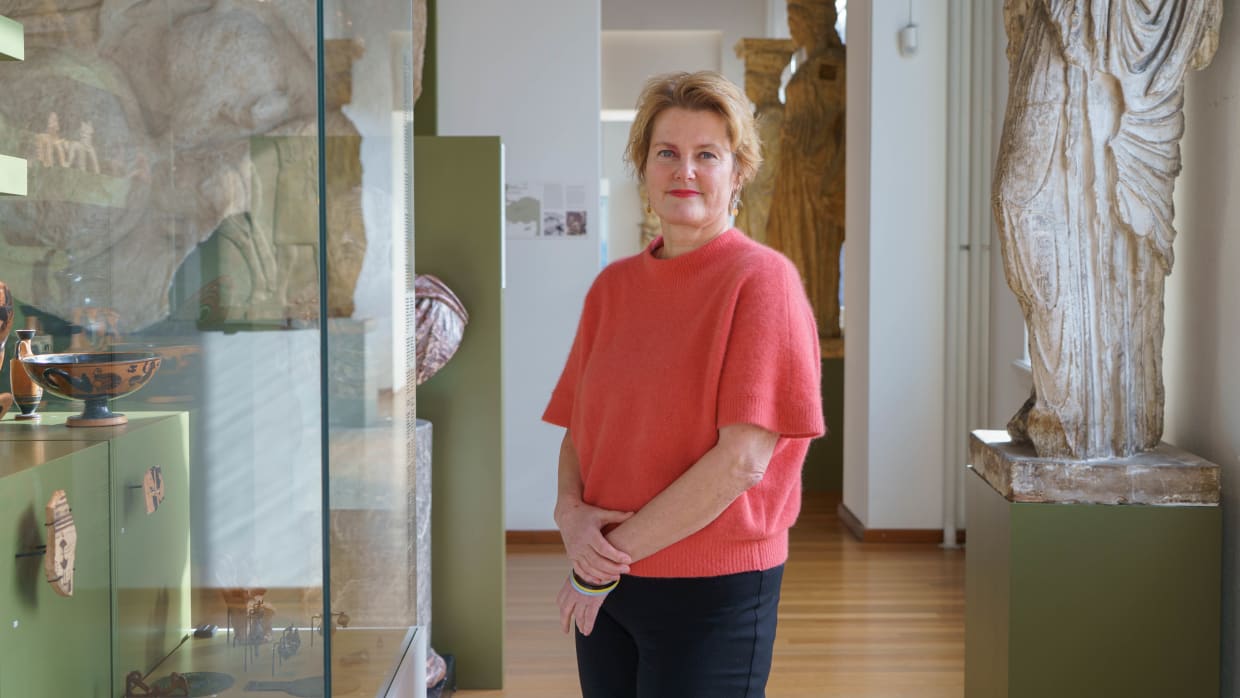
Bronze figurines, coins and all kinds of vases, but also beauty cases from before the Common Era and a golden band to keep the jaws of the deceased closed. In recent weeks, UvA archaeologist Anne Versloot has been examining all the objects that ended up in the Allard Pierson Museum via the Greek art dealer Athanasios Rhousopoulos (1823-1898).
“Take this shard here, for example,” Versloot points to the display case in the Greek antiquites section. “When you turn it over, you see a blue label that says ‘1882, Tanagra’. That probably means it was excavated in 1882 in Tanagra, a famous excavation site in Greece known for its female figurines.”
And could that be correct?
“Yes, probably. At the end of the 19th century, a huge trade in Greek antiquities took off in Europe. The Greek art dealer Athanasios Rhousopoulos played an important role in this. The Allard Pierson Museum has around 150 objects that came here via Mr Rhousopoulos. But the exact provenance of these objects is still largely unclear.”
Why is that interesting?
“Because we also know that mister Rhousopoulos was capable of cheating. He was a professor of archaeology and had a gallery at home. Between 1860 and 1890, he was one of the most influential art dealers in Athens. His status as a professor gave his customers a sense of reliability, a scientific veneer. Empress Sissy, for example, visited him, as did Dutch collectors including Jan Six VII and Constant Lunsingh Scheurleer.whose extensive collection later came into the possession of the Allard Pierson Museum”
Was it possible at that time, as an archaeologist, to sell your finds?
“That’s unimaginable now. And even back then, it was controversial, but it did happen. The subject wasn’t yet a political issue and the laws weren’t as strict. In Rhousopoulos’s day, you were allowed to sell excavations from your own land to the highest bidder. And officially, there was a law that prohibited the export of antiquities abroad.”
In 2026, a total of eleven researchers started a three-month Fellowship at Allard Pierson. In addition to Anne Versloot, UvA researcher Daniël Knegt and UvA alumni Ella Campbell and Olivia Schoenfeld also received a grant, which is being awarded for the third time this year. Applications for a 2027 Fellowship will open in the summer.
“But that law was not always enforced. Sales had to be reported to the Greek State Archaeological Service, which did not have the funds or manpower to monitor everything. A three-person service did its best, but mister. Rhousopoulos himself was regularly part of the service. The service could then decide that a vase was worthless, or that the Greek state already had many of them.”
How did Rhousopoulos abuse his position?
“He once sold an aryballos, a small round oil vase, to the British Museum. When the archaeological service found out in 1865, he was reprimanded. In a letter to the archaeological service, he wrote that they were jealous of his sale. And that it was a vase ‘no bigger than an apple’, worth no more than twenty-five drachmas. However, we know from other letters that he sold the vase for a thousand drachmas, three times his monthly salary. That’s how he arranged things.”
Was he ever criticised for this?
“He did leave the university early for vague reasons. Officially because he was too old, but he was 61 or 62. Perhaps he was ill, we don’t know. He was also dismissed prematurely from the archaeological service because his activities were considered incompatible.”
Provenance research has become increasingly important in recent years, including at Allard Pierson. In 2023, the museum announced that it would review its own archaeological collections following restitution requests from Italy. That research project will continue until 2027. Anne Versloot’s Fellowship is part of the provenance research.
What do you hope to find out about the provenance of Rhousopoulos’ objects in the Allard Pierson?
“When researching provenance, it is best if you know exactly what journey an object has taken and how it was excavated. But that is almost never possible. Researching the provenance of Greek antiquities simply takes a very long time. It would be great if the government provided funding for this, just as it does for research into art treasures from the colonial past and looted art from the Second World War.”
“Hopefully, this research will reveal more about how mister Rhousopoulos worked. And, together with research from abroad, it may help to map out his network in Europe.”
What will museum visitors notice?
“That depends. If objects obtained under dubious circumstances turn up in the collection, the Allard Pierson will discuss this with the Greek authorities. And then there is also the option of returning such an object. In any case, the museum will communicate about this, with an article on the website or a special exhibition. Anything is possible; there is no reason to be vague about it.”
And signs next to the objects in the museum?
“If you put signs next to everything, visitors will spend hours reading. But a QR code in the room that leads you to a podcast about art dealers, is a possibility. That’s a subject that mainly archaeologists are interested in, but perhaps the general public would also find it interesting. And not just about Rhousopoulos, but also other dealers.”