Finally a portrait of a woman in Agnietenkapel? No change a year after student proposal
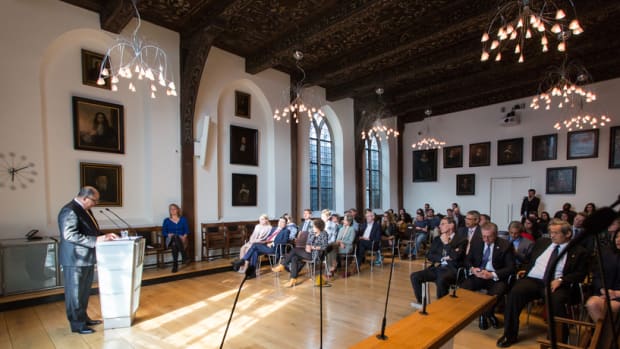
There is not a single portrait of a woman or a person of colour in the Agnietenkapel. However, the auditorium, where nearly seven hundred PhD students graduate each year, features 38 portraits of old, white men. Exactly one year after UvA students submitted a proposal for a new interior design for the chapel, little change is visible.
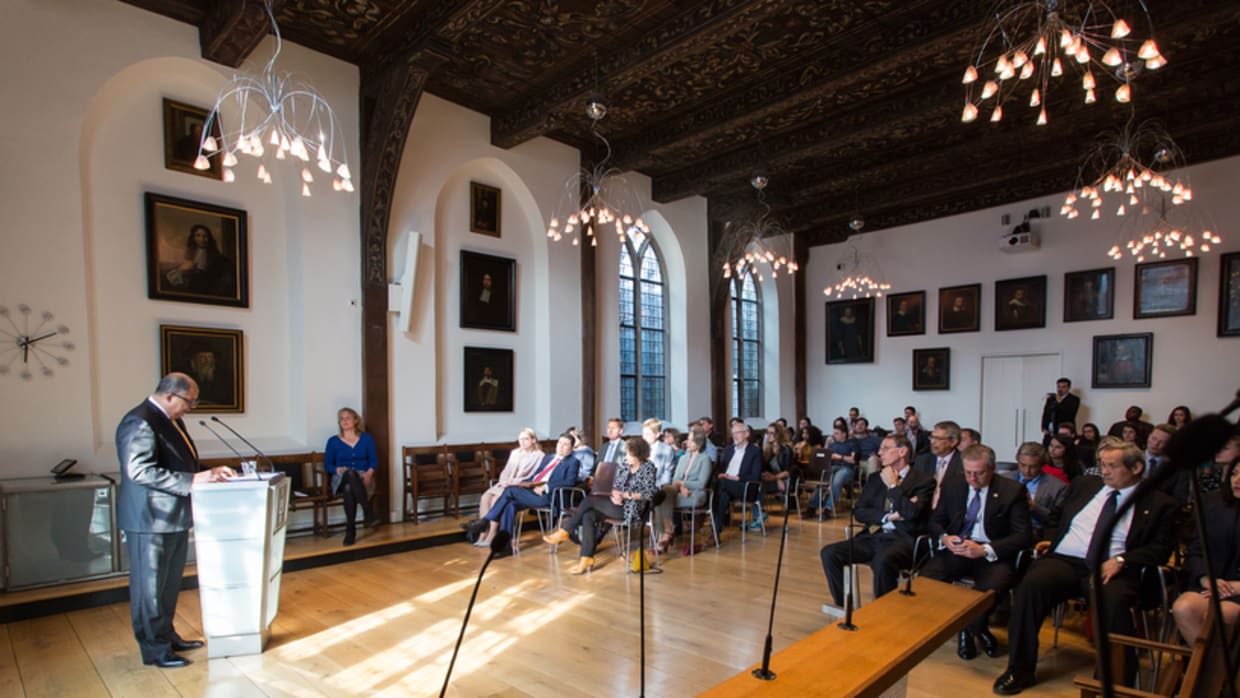
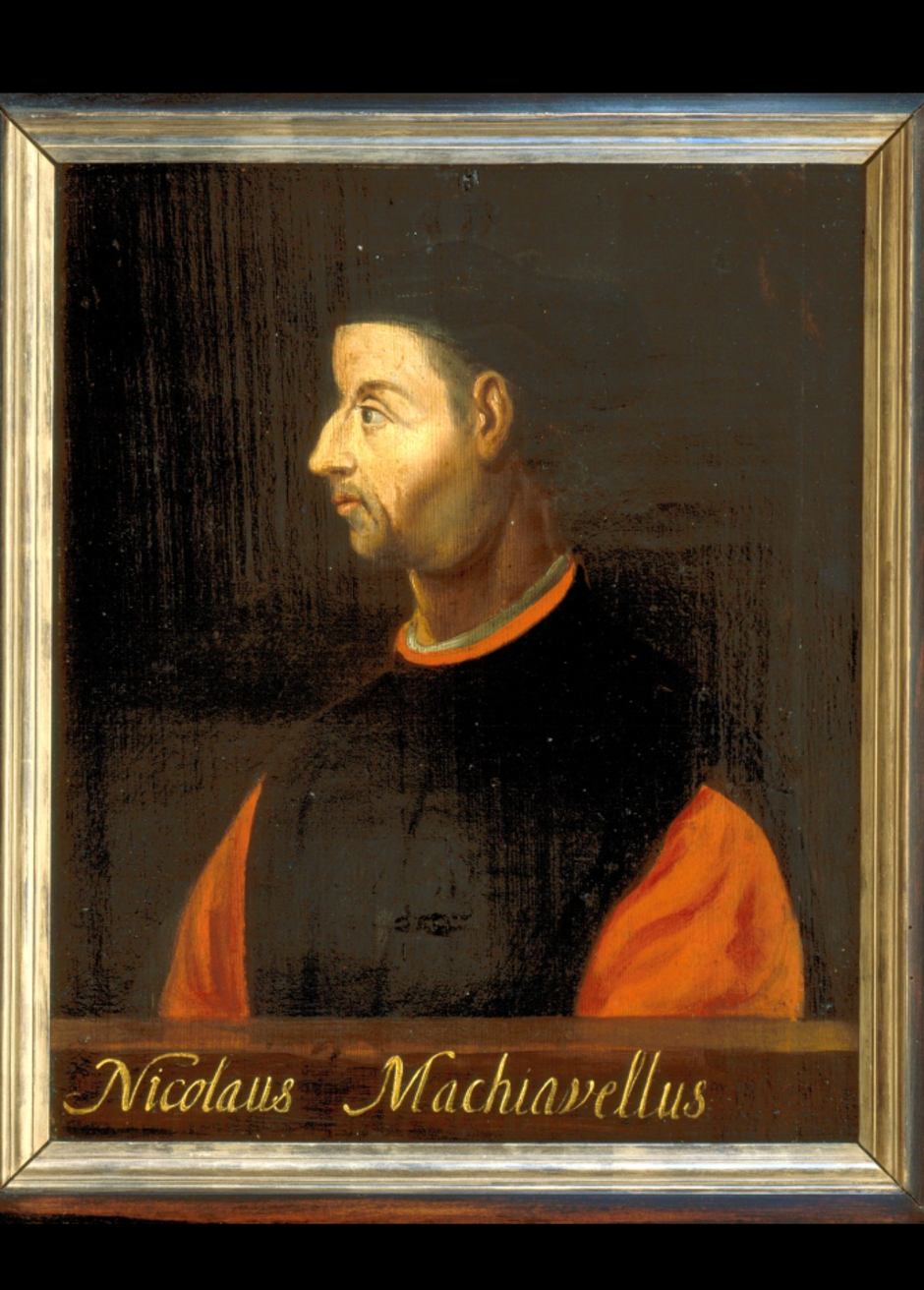
Doctoral defences in the Agnietenkapel still take place under the watchful eye of thirty-eight portraits of white men. These portraits represent scholars affiliated with the UvA – such as Vossius and Barlaeus – but also scholars, statesmen and humanists who have little to do with the UvA, such as Hugo de Groot, Machiavelli and Erasmus. The paintings are part of the Van Papenbroeck collection, a collection of 49 paintings donated by the Amsterdam merchant Gerard van Papenbroeck (1673-1743) to the Athenaeum Illustre, the predecessor of the UvA.
The discussion about the Agnietenkapel is part of a broader discourse on the representation of science in paintings. Leiden University already added fourteen portraits of female professors to the Senate Room in 2018, the room where, according to tradition, all former rectors, professors and other important academic figures are depicted. The University of Groningen followed suit with eleven portraits. In 2023, Radboud University in Nijmegen commissioned an artist to design thirty portraits of female professors for the Senate Room.
The Senate Room of the University of Amsterdam is located in the Old Lutheran Church, the University of Amsterdam’s auditorium and the second location where you can obtain a doctorate at the University of Amsterdam. Two women are currently represented there: Rector Magnificus of the University of Amsterdam Dymph van den Boom and former Chair of the Executive Board Geert ten Dam.
Previously, the paintings from the Van Papenbroeck collection in the Athenaeum Room, the room in the Agnietenkapel where the doctoral committee makes its decisions, had already been removed by the UvA in the interests of diversity.
In recent years, there has been regular criticism about why these particular portraits are on display. PhD students have commented on this or sent emails to the Rector’s Office. Recently, PhD candidate Judith de Jong organised a campaign to display portraits of women and people of colour during her thesis defence, which was about the representation of citizens with a migrant background in politics. Her aim was to make a statement that there is still room for improvement in terms of representation, not only in politics but also in academia.
One of the complaints ultimately led University Secretary Leon van de Zande, on behalf of the Executive Board, to commission students from the Master’s programme in Public History last year to come up with an alternative design for the Agnietenkapel. So far, little change is visible in the chapel.
A portrait for every PhD student
“If you are a woman of non-Dutch origin doing a PhD at the UvA and you only see Western, white, old men looking down on you, that is not a very inspiring start to your academic career,” says Renée Evers, a former Master’s student in Public History, in a video interview with Folia. Together with students Annelyn Heida, Lou Steiner and Pieter van Iwaarden, she presented the winning proposal last year before Christmas to bring the Agnietenkapel more in line with modern times.
The assignment was to design a “new museum layout” that “does justice to the history of doctoral studies at the UvA and represents different groups”. Among other things, the students proposed a Wall of Fame: a wall in the reception area where a small portrait of each PhD candidate would be displayed. Evers: “So that you get a one-to-one representation of the PhD candidates at the UvA.” That idea was inspired by the handmade portraits that beadle Rob Vink makes of PhD candidates.
To make the history of the chapel more accessible to the public, the students proposed a table in the reception area with a touch screen displaying a timeline of the history of the Agnietenkapel. The 38 paintings would also be made visible here so that history would not be “erased” in the event of a possible redesign.
Diversity networks
The students also proposed retaining twenty portraits from the Van Papenbroeck collection in the auditorium and adding portraits of female scientists and scientists of colour. These portraits would have to be painted in “the same style” as the 15th and 17th-century portraits. The students did not decide which portraits should be removed and which should replace them. Heida: “We ultimately felt that this decision should be left to the seven faculties of the UvA. They should come up with names of academics who have done something they are proud of.”
The diversity networks and Diversity Officers should be consulted in the final decision-making process, the students decided. During the project, they were in contact with UvA Pride, UvA Ideas and student associations such as the Association for Asian Students and African Students United.
Starting signal
But things are not that far along yet. In the meantime, a design agency has been selected, Rector Magnificus Peter-Paul Verbeek announced via LinkedIn, which will work on the students’ proposal. The Amsterdam-based design agency Xpex is expected to complete the redesign of the reception area in the course of the 2026-2027 academic year. The redesign of the auditorium will therefore have to wait a little longer.
The students are disappointed that no steps have yet been taken with regard to a plan for the auditorium in the Agnietenkapel. Heida: “The auditorium is the most important room because that is where the ceremony takes place.” Evers calls it “cowardly” that the UvA has not yet started. “Apparently, all those white men in those lists have a certain prestige that cannot be easily dismissed. And it is still necessary for students to kick things off with a demonstration or an angry email and reignite the discussion.”
Advisory committee
According to Annelies Dijkstra, head of the Rector’s Office, it is “unfortunately the reality” that these kinds of projects take longer. “We are very pleased that we recently found a design agency. And the final design will really reflect a lot of the students’ proposal.” According to Dijkstra, this was a free assignment for students with no budget limit, and it was never said that it would be adopted in its entirety.
The redesign of the lecture hall is phase two. Dijkstra: “That is a complicated issue. There is a lot to be said about it, and that discussion will come at some point. It is something that an advisory committee will ultimately have to consider.”
For the time being, the men of Van Papenbroek still rule the roost in the auditorium. And the action taken by PhD candidate Judith de Jong was called back by the Rector’s Office. The portraits of women and people of colour were only allowed to be visible during the layman’s talk, the introduction for a wider audience prior to the PhD ceremony. During the official part, the portraits had to be completely out of sight: a transparent plastic bag was not sufficient. And so the day when the first portrait of a woman will be visible at the doctoral ceremony in the Agnietenkapel is still waiting to be seen.