Melting sea ice changes the color of the ocean

Melting sea ice not only changes the amount of light that enters the ocean, but also its color. This has consequences for algae that live off the light and absorb the greenhouse gas CO₂, and therefore for the climate, as UvA biologists Monika Soja-Woźniak and Jef Huisman have discovered.
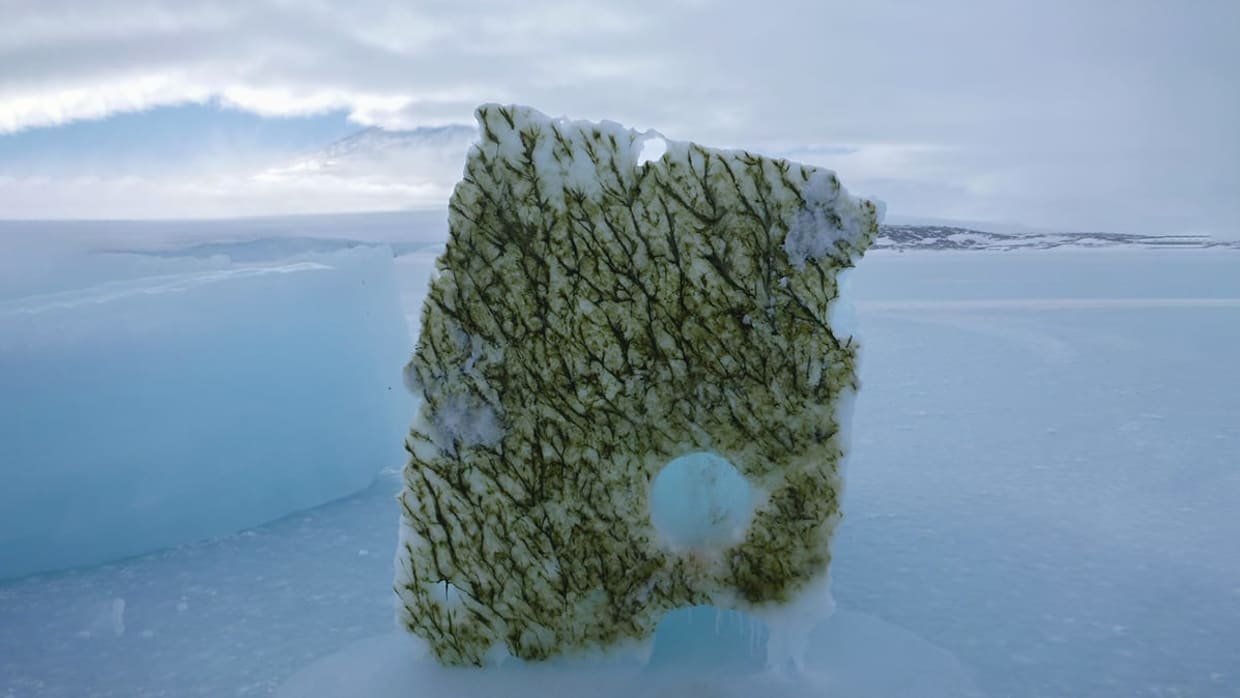
Melting sea ice is one of the most important pieces of evidence that the Earth is warming. After a warm February, historically low levels of sea ice were measured at the North and South Poles. Over the past few decades, sea ice has been melting rapidly, especially in the Arctic Ocean at the North Pole, says UvA professor of aquatic microbial ecology Jef Huisman. “The prediction is that in 20 to 30 years the Arctic Ocean will be ice-freeBy “ice-free” is meant that no large-scale areas are covered with ice; there will still be isolated patches of sea ice. in summer. In the Antarctic, the decline in sea ice only started about 10 years ago, but even there it is now accelerating rapidly.”
The shrinking ice surface has all kinds of consequences. It opens up new shipping lanes, and that endangers the lives of polar animals. Moreover, melting sea ice is a self-reinforcing process; as more sea ice melts, the earth warms even faster because seawater retains more heat than ice.
A less obvious consequence of melting sea ice is that it changes the color of the Arctic and Antarctic Seas. The difference in light color between sea ice and the open sea was recently published in a scientific paper co-authored by UvA researcher Monika Woźniak along with UvA colleagues Sander Woutersen and Huisman. Huisman explains: “Sea ice reflects and scatters all colors of light and is therefore white in color. The color changes when the ice melts, because seawater reflects and scatters light less than sea ice. Seawater mainly absorbs the red and green parts of the light spectrum, while the blue light remains. So that’s why the ocean looks blue,” says Huisman.
It was already clear that melting sea ice changes the color of the ocean, but UvA researchers have now mapped out exactly how this works. “An important underlying cause of the shifts in light color has to do with the change in molecular vibrations of water molecules (H₂O) in ice and water,” says Huisman. In liquid water, the H₂O molecules can move freely (vibrate), whereas in ice, the water molecules are fixed. Huisman explains that the vibration of water molecules in liquid water causes a number of specific wavelengths of the light spectrum to be absorbed. Because the water molecules in ice cannot move freely, less of the light spectrum is absorbed, leaving more wavelengths of the light spectrum behind. “This fundamental difference in the behavior of H₂O molecules in ice and water contributes to the change in light color,” says Huisman.
Base of ecosystem changes
According to Huisman, the change in light color could have major consequences for the ecosystem in the polar regions. The chain reaction in the ecosystem starts with diatoms that live in or under sea ice and could disappear as a result of melting sea ice. Ice algae, including these diatoms, are at the bottom of the food pyramid, which means that they form the basis of all energy in a food chain. If something happens to this base layer, the entire ecosystem can change, says Huisman. And this is already happening. “In the sea north of Canada, diatoms are being displaced by a much smaller species of algae that is better adapted to life without sea ice,” says Huisman. “We are the first to look at the effect of changing sea color on the primary basis of the ecosystem.” Huisman cannot say how serious this change in the ecosystem is, because the exact consequences have not yet been investigated.
The reason these diatoms struggle when the ice melts is because they find it harder to capture light in the open sea. Like plants, diatoms use photosynthesis: they use light and the greenhouse gas CO₂ to produce energy. Ice algae produce different pigments, which are colorants that can capture a certain color of light. The algae use pigments to absorb light for photosynthesis. “When the ice melts, not every color of light is available in the ocean, which means that diatoms produce some of their pigments for nothing,” says Huisman. The smaller algae in Canada that are now taking the place of diatoms mainly produce pigments that absorb blue light, making them optimally adapted to an environment where there is a lot of blue light available.
This fate does not apply to every species at the bottom of the food chain, Huisman said. The Antarctic foam alga - another alga that performs photosynthesis and lives in the polar sea - can adapt its pigments to the change in light color in the sea due to melting sea ice. “So this species is less likely to be competed away by other species,” Huisman said.
Forgotten factor in climate models
According to Huisman, the influence of changing light color is totally new in climate and ecosystem models of the polar regions. “Most models focus mainly on the difference in reflection between ice and water - ice reflects more light, water absorbs light. But what is forgotten is that not all colors of light are absorbed in the same way. The color shift in ocean water is new territory.”
This shift in ocean color not only affects marine life, but also has potential feedback on climate. Algae, for example, convert carbon dioxide into oxygen through photosynthesis, thus capturing some of the greenhouse gas CO₂ from the atmosphere. “For the photosynthesis of algae, light color is crucial. If you want to model the major effect of algae on global CO₂ concentrations for climate models, you have to take into account what light color is available.” And that is not happening so far, according to Huisman. Even for researchers studying ecosystems in the poles, the change in the base of the food web is important to include, according to Huisman.
Exactly what the changes in light color mean for global climate is not yet clear, Huisman said. “I do suspect that this effect is present. But climate models have yet to show exactly what might happen.”