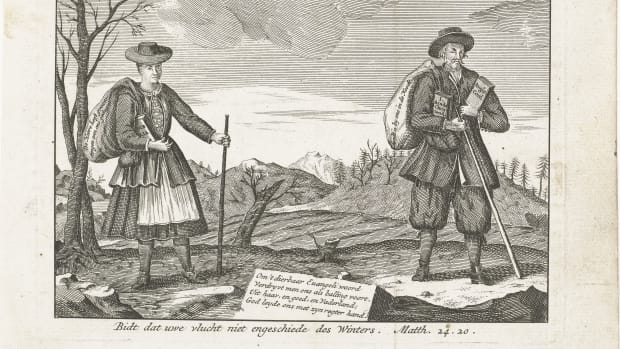
Historical research: who is emigrant and who is refugee?

What did the Dutch think of migrants in the early modern period (sixteenth to eighteenth century)? University of Amsterdam doctoral candidate Lotte van Hasselt delved into city archives, read old newspapers and analyzed letters to learn how authorities decided which emigrants deserved help.

The migration debate was already a sensitive topic in the seventeenth century. This was evident from so-called ‘shame boards‘, on which ‘false refugees‘ were publicly shamed for not being who they pretended to be.
In her thesis, archaeologist and historian Lotte van Hasselt shows that the discussion about refugees is centuries old. But how do you find out how the Dutch decided to deal with refugees in the early modern period? Van Hasselt traveled all over the Netherlands in search of archives, letters and newspapers and revealed how sensitive the topic of migration already was at the time.

First time in history
Van Hasselt discovered that the terms ‘emigrant‘ and ‘refugee‘ had a different meaning at the end of the eighteenth century than they do today. “These terms mainly indicated which region the migrants came from: Protestant people from Salzburg who were exiled by the Catholic archbishop and emigrated to Zeeland were referred to as ‘emigrants‘, for example, while the term ‘refugee‘ could refer to French Protestants, the so-called Huguenots, who were persecuted in Catholic France.”
“Even if both groups left their countries for similar reasons, they were labeled differently based on their geographical origin,” says Van Hasselt. ”And I found that remarkable because nowadays an ‘emigrant‘ refers to someone who leaves of their own accord, while a ‘refugee‘ flees violence and persecution. Because the Republic of the Seven United Netherlands – as the Netherlands was called at the time – presented itself as a safe haven for Protestant refugees, both groups were taken in. Yet different terms were used, while the only difference was that they came from different areas.”
Refugee Convention
”It was the first time in European history that authorities distinguished between those who did and did not deserve help,” says Van Hasselt. ”Now we have the international Refugee Convention to determine who should receive help.” During the time of the Republic, it was determined on a city or provincial level whether a refugee emigrant would receive aid. “It was organized on a very local level and there was no national policy for foreigners,” says Van Hasselt.
Political position
How did the various regional authorities feel about emigrants and why? To find out, Van Hasselt delved into various archives from Groningen to Zeeland and from Amsterdam to Rotterdam. She focused on certain words when sifting through the old archives. “I was looking for terms such as ‘refugee‘, ‘persecuted‘, ‘expellee‘ or ‘expatriate‘. I also looked closely at administrative meeting minutes and decisions made by administrative bodies regarding displaced people.“
Van Hasselt discovered that the political strategy of stadtholder king William III played a major role for French Protestants, the Huguenots. “He saw the Protestant refugees from France as a tool to emphasize the dangers of a strong France and the French oppression of Protestants. In doing so, he tried to prevent the Republic from reducing its military power and weakening his political position.“

Stand in their shoes
Protestant pastors from the Palts, in what is now southwestern Germany, had to flee due to religious persecution. Many of them ended up in border towns around the Republic, where they gathered with fellow believers and sent letters to Reformed churches in the Republic to ask for help.
Van Hasselt found one of these letters with a special story. “I really liked the fact that these letters were preserved. In the letters, the pastors use rhetorical devices such as imagery and exaggeration to describe their terrible circumstances in the border towns around the Republic in order to convince the recipient to send money. What I found particularly interesting about one letter was that a passage from the Bible had been written in the margin as a reference to the famine they were experiencing.“
Van Hasselt: “The letters came closest to the people themselves. Unlike the meeting minutes, which were not written by the refugees themselves, the letters revealed the horrors they had experienced. That helped me to better understand their situation.” Because she also came across the meeting minutes from the churches that discussed the desperate letters during meetings, she knew that these letters were being taken seriously.
Real refugee or not
Van Hasselt also came across a remarkable newspaper article from 1688 in which pretending-to-be Huguenots were publicly shamed. In the ‘early modern‘ newspaper, Van Hasselt read that six to eight men and women from The Hague were fleeing with a sign on their chests that read ‘false refugee‘. Van Hasselt: “These people probably had presented themselves as being Huguenots because they were given privileges such as tax breaks and access to citizenship and the guild. The pamphlet promising these privileges also stated that it was not okay for people to present themselves as religious refugees. And this was probably a consequence of that.“
“I find it fascinating that the distinction between who was and who wasn‘t a real refugee was also an issue back then,“ says Van Hasselt about the shame boards. Because public opinion about refugees could swing so dramatically from positive to negative, she draws a comparison with today. “Despite the treaties about who is or is not a refugee, you can see that this term is still fluid, just like four centuries ago. The view of who is a refugee can suddenly change if the refugee does not deliver what is expected of them. Then suddenly there is a hardening of attitudes and people are cast aside.“
Van Hasselt hopes that her research can add nuance to the contemporary migration debate. “I think that the past differs surprisingly little from the present, except that at the time, much more consideration was given to the economic benefits that refugees could bring. That is now considered much less.“