We need not take seriously a boycott that everyone already knows does not work

A group of academics and students mistakenly claim that the Netherlands can stop a war thousands of kilometres away by severing university ties with Israel, writes sociologist Jeroen Bruggeman. According to him, this sounds so other-worldly that it can hardly be taken seriously. Or is there something else behind it, he wonders.
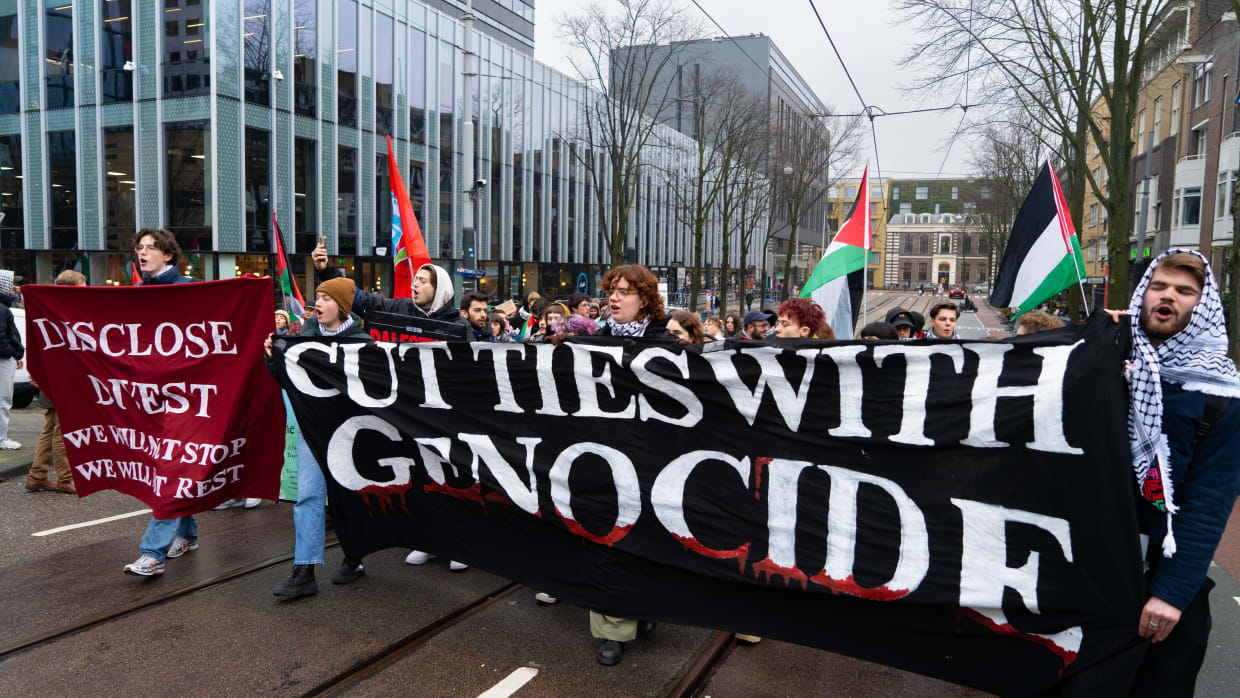
Indeed, there is no scientific evidence that an academic boycott can reduce the number of deaths, but proponents exempt themselves en masse from the burden of proof as soon as it comes to actions against Israel. If you point this out to protesters, you get a big mouth back, which is the best evidence that one has no proof.
There is, however, evidence that an arms boycott helps. It forces Israel to talk to the Palestinians instead of shooting at them. For the Netherlands, however, an arms boycott has been rejected by the Dutch courts.
Career damage
Should scientists call for boycotting the US (Israel’s major arms supplier), they would do their own careers considerable damage: no more American publications, conferences, projects and sabbaticals. But that is going too far for them: for they are not willing to actually sacrifice anything for the Palestinians. That is also why they don’t take in Palestinians, unlike others who took in Ukrainians but don’t speak highly of them. By the way, a boycott of the US would not help either, but would be a cool gesture.
Boycotting Israel does not hurt careers, while the costs of the protests are passed on to taxpayers. These costs consist of salaries continued to be paid at demonstrations, extra security, rent for almost empty buildings, repair of material damage and sick leave of Jewish employees who had nothing to do with the war but were discriminated against and intimidated by protesters, not to mention the psychological damage.
Meanwhile, protesters flaunt their moral superiority in a mutual competition for status. If Ghent University breaks ties, the Dutch universities immediately follow, and within the universities some try to be even purer in doctrine than others. In this race, the key is to follow the latest fashions to avoid being left out. French sociologist Pierre Bourdieu wrote on the concept of ‘taste’ that those who want to rise socially regularly embrace a new genre of music or art to distinguish themselves from others.
Moral competition operates on the same principle, with political issues taking the place of genres. From gender-neutral toilets, we went through Black lives matter to overall inclusiveness. But don’t get into that now and chant: “No Zionists here!” The lofty morality appears to be of rubber and bend with every ideology, while inclusivity has come to virtually nothing. How many black people have joined? In my department, one in a hundred employees. And right-wing people? In my department, zero. The only achievement is the gender-neutral toilet. Meanwhile, many protesters for those issues have switched to the Palestinian issue. Under social pressure or a naive desire to belong to something good, a new batch of academics has also joined in. Both naivety and desire proved to be quite contagious.
Three smokescreens
To avoid falling through the cracks immediately, the protesting academics put up three smokescreens. Just weeks after the start of the war against Hamas, they organised teach-ins that portrayed the history of Palestine and Israel as a caricature of good and evil. This has nothing to do with facts and science, although most listeners are unaware of this. Also, many universities have not taken timely measures to keep teach-ins off campus.
The second smokescreen is the factually correct assertion that Israeli universities with which the Netherlands has ties also employ people who (side-)work for the military. But this suggests guilt where there usually is none. If a Dutch archaeologist does excavations with an Israeli colleague, this does not make the Dutch archaeologist complicit in murder, even though this Israeli archaeologist may have colleagues or acquaintances at a military research institute: you can make up a group for any combination of individuals in which they are all in (the whole of humanity, if necessary) and then hold everyone in that group responsible for the violence of some, but the choice of group is arbitrary, opportunistic and legally untenable. This is obviously different in the case of US collaborations in particular, which are aimed at developing weapons.
As a third smokescreen, protesters wriggle into victimhood and complain bitterly that their right to demonstrate is being curtailed. Meanwhile, they demonstrate more than anyone else and actually attract more attention because of the backlash. Were everyone to immediately agree with them, the fun would be gone and they would have to quickly find another cause to score hero-on-socks points.
Gratuitous morality
Because a silent majority sets no limits to this gratuitous moralistic display, especially in the social sciences, competition for good scientific ideas has been stifled. The problem is not just that honourable strivers for status draw too much attention to their ideological issues, but mainly that they demand academic recognition for them. To give an example: until recently, it was impossible in sociology to publish a paper that explained antisocial behaviour partly by biological factors. This was due to ideologues from the previous century who claimed that antisocial behaviour is determined solely by the environment and not by predisposition or biological factors, the famous nature-nurture debate. This nonsensical idea was noted and their supporters were given positions and grants, keeping an entire scientific field under their thumb for decades. Thus, there is now a danger that propaganda from teach-ins will be transferred to the curriculum and become normative in grant applications.
Demonstrating and striking is everyone’s right, but we had better be vigilant that no one gets academic recognition for this. This should be reserved for scientific achievements, so that science remains relevant and education neutral. In any case, we do not need to take seriously a boycott that everyone already knows does not work.
Jeroen Bruggeman is associate professor of cultural sociology at the UvA.