More rooms, less loneliness: what the new Amsterdam coalition wants for students

Stricter enforcement against excessive rents, more temporary student housing, and a tougher approach to loneliness. In the new coalition agreement, “Your City Is My City. Our Amsterdam”, Pro Amsterdam and D66 outline their plans for the city. But what does this agreement mean in practice for (UvA) students? An overview of the most relevant ambitions.
“Implementation and action.” That is what the new coalition agreement presented yesterday by Pro Amsterdam and D66 aims to deliver for the city of Amsterdam. Whether that promise will become reality for Amsterdam’s students remains to be seen, but the agreement does contain a series of concrete ambitions: particularly in the area of student housing.
The most important plans for UvA students at a glance:
Student housing:

- Stricter enforcement of rent regulations. The new coalition plans to actively inspect rental properties to ensure that rents comply with the Affordable Rent Act (Wet Betaalbare Huur). This law significantly expanded tenant protections by introducing a stricter points-based system with corresponding maximum rent levels. Inspections will begin with student housing.
- More funding for student housing. An additional €1 million per year will be allocated to student accommodation. Together with students, educational institutions, and housing associations, the coalition aims to ensure the availability of “sufficient, affordable, and suitable student housing.” Particular emphasis will be placed on housing arrangements where three or more students live together.
- Educational institutions will be asked to make land available for student housing. Universities and colleges will be encouraged to provide space on their own premises for new student accommodation. The UvA is already developing long-term plans for a residential tower containing 350 to 400 housing units, according to the university’s recently published housing plan.
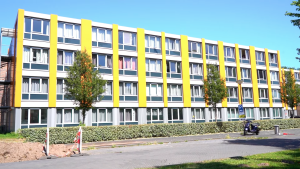
- An additional 1,000 temporary homes will be built, some of which are intended to be made available to students. These homes are specifically aimed at urgent housing seekers – people who are temporarily in a difficult housing situation – and come on top of the 1,500 temporary homes already planned. It is not yet clear how many of these units will be reserved for students.
- Priority access for Amsterdam residents to youth housing will be abolished. While this does not directly affect current students, it could make the search for housing slightly more difficult for recently graduated young people from Amsterdam.
Student life:

- The new coalition wants to provide better support for students in tackling loneliness and improving mental health. According to Pro Amsterdam and D66, the decision to focus new student housing projects on living arrangements where three or more students share accommodation is also partly intended to combat loneliness.
- The coalition recognises nightlife as a “fully-fledged part of Amsterdam’s arts and culture policy”. It aims to give club culture “a new impulse” and reduce regulatory burdens for organisers. In addition, the city will explore whether iconic venues such as Paradiso can be designated as intangible cultural heritage.
- Pro Amsterdam and D66 want to expand the availability of public transport during the night. The parties also say they will continue working on the creation of safe, well-lit cycling routes throughout the city.
With the university:
- Amsterdam should become a frontrunner in “responsible technology.” To achieve this, the coalition plans to establish a partnership involving, among others, tech entrepreneurs and knowledge institutions.
- The new coalition wants to make agreements with educational and research institutions on programmes that offer clear prospects for employment in sectors that are crucial to the city’s future.
- An additional €3 million will be invested in cooperation with Amsterdam-based knowledge institutions, including the UvA. Part of this funding is intended to support the development of a broad knowledge agenda and to strengthen the role of the Chief Science Officer (CSO) — a central link between the municipality and local knowledge institutions, tasked with using scientific research and innovation to help address urban challenges.