UvA student sails with flotilla to Gaza: “We are preparing for the worst”

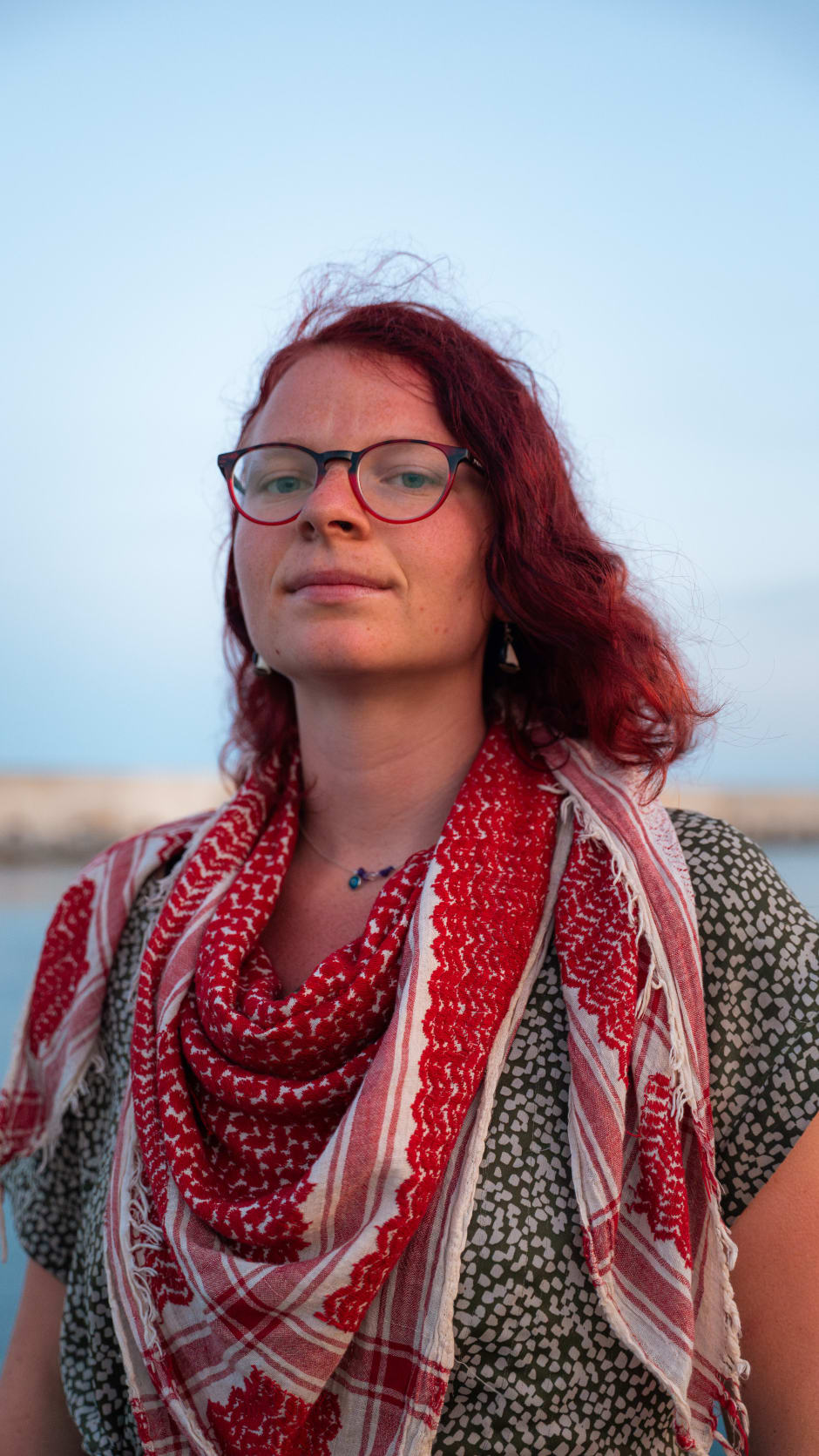
Her fellow students will not be seeing 21-year-old Jesse van Schaik in the lecture halls for the time being. The history student has been at sea on the Mediterranean for a week now. Van Schaik is sailing with the Global Sumud Flotilla, a fleet heading towards Gaza in an attempt to deliver humanitarian aid.

The first week at sea is over. Has the journey got off to a smooth start?
“Yes, life on the boat is actually going quite well. We set off from Barcelona on 15 April, and since then we’ve been sailing day and night. We’re now about fifty nautical miles (just over ninety kilometres) off the coast of Sicily. There’s always something that needs doing on board. Life at sea mainly consists of a lot of repairs, but fortunately there are eight of us on this boat and we’re part of a flotilla of a thousand people. Each of the boats in the fleet carries six to eight crew members. Although there are eight of us on our boat, there are only six berths. In practice, that’s not really a problem, as two crew members have to stay awake each night to keep watch anyway.”
You are sailing with this flotilla in the hope of breaking the Israeli blockade and delivering aid to Gaza. That is not without risk: in the past, activist ships like this have been intercepted by the Israeli military. What motivates you to take part in this action?
“For me, this is the most basic and important thing I could possibly do. I felt desperate, angry and deeply saddened all at once. Every day, the world loses a bit more of its humanity, and I want to do what I can to push back against that. We are not the heroes who will liberate the Palestinians, but we do want to challenge the indifference in the world. The only difference between me and the students in Palestine who have been killed is where we were born. I therefore want to use my privilege for this, and that’s why I have previously been involved in many actions at the university as well.”
Speaking of the university, how are you combining this journey with your studies?
“I’m in the third year of my bachelor’s, so I would normally be graduating this semester, but right now I obviously can’t work on my dissertation. I didn’t bring a laptop, and I also want to be able to focus fully on my dissertation once I’m back. So I’ll be delayed by a semester.”
Have your lecturers been willing to accommodate you?
“Yes, I’ve received a great deal of support from lecturers. Within the limits of what’s possible, they’ve been very understanding. It’s not as if I’m being exempted from anything, but for example, I was allowed to record a presentation, which I was supposed to give in person, from the harbour in Barcelona. So I am given some flexibility, but I’m certainly not just handed a top mark without doing any work.”
“Some lecturers even actively encouraged me to go on this journey, because this is such a critical moment in world history. This is not a pleasure trip. I feel that, as a history student, I should be present at this historical moment. As an academic, I want to be engaged with the real world as well.”
How long do you expect the journey to take?
“That depends on the weather, but also on the bureaucratic obstacles we may encounter. We’re still figuring out where we can make a stopover now that Tunisia is no longer willing to receive us, but we expect to be travelling for at least another five weeks.”
Even so, the chances of you actually reaching Gaza are small.
“Of course, we set out with the idea that we will arrive in Gaza, that is the plan. But we are also taking into account the possibility that we may be intercepted and abducted by Israel along the way. There is a strong chance that serious violence could be involved, so we are preparing for the worst. We’ll be arriving with a flotilla of a thousand people, and I expect that could be a reason for Israel to escalate.”
“That’s why we talk a lot on board about what we might expect from the Israeli military. We regularly train for what to do if an interception occurs, and how to position ourselves on the boat if soldiers come on board. It’s not pleasant, but it is important to discuss.”
A stark contrast with the student life you have left behind here.
“Yes, it’s definitely very strange. If all goes well, I’ll simply have a course to finish in May and June. The day after I return, I’ll probably already be back at the UvA. But what feels even stranger is thinking about the scenario in which we might not be able to return at all. We don’t dwell on that too much on board; there’s little point. In the end, it wasn’t a reason for any of us not to go.”