
UvA recruits abroad online, despite agreements between universities

Despite joint agreements among Dutch universities to stop recruiting students abroad, the UvA continues to do so through online advertisements. Data from Meta and Google show that the university is running paid campaigns in several countries on Facebook, Instagram, and Google.

“Which Bachelor’s will you choose?” Anyone scrolling through their Facebook or Instagram feed in Kraków, Berlin, or Florence might come across this text in an advertisement from the UvA. It is a promotion for the upcoming Bachelor Week, which is visible in several European countries. The fact that this advertisement is being distributed there is striking: universities have agreed to stop actively recruiting international students – except in so-called ‘shortage sectors’.
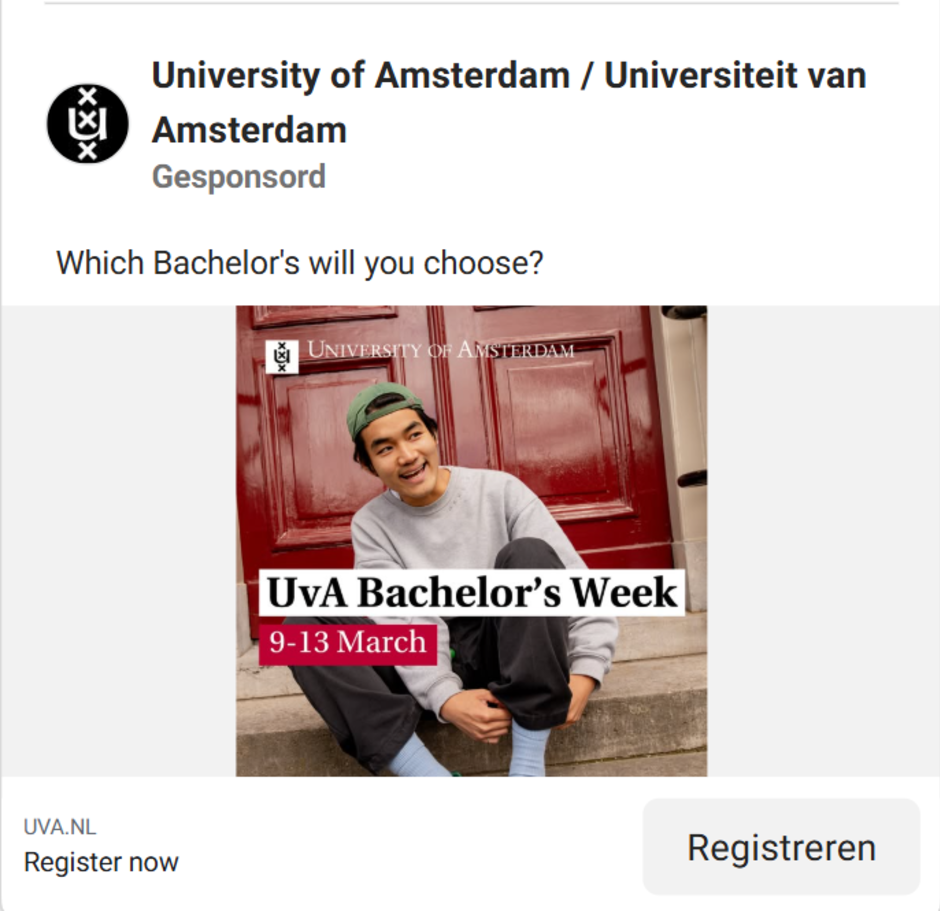
Yet the UvA is doing so online. In the current academic year alone, the university has placed at least 136 different paid campaigns in seven foreign EU countries. This is evident from publicly available information in the Ad Library of Facebook’s parent company Meta. According to Meta’s estimates, these advertisements have been viewed more than 2.4 million times in total by non-Dutch users. They mainly concern general promotions for the university’s Bachelor’s and Master’s Weeks.
Agreement between universities
The agreement that universities would exercise restraint in recruiting international students followed a call in 2022 from then Minister of Education, Robbert Dijkgraaf. At the time, Dijkgraaf asked universities to stop actively recruiting international students due to concerns about capacity problems – such as a severe shortage of student housing, overcrowded lecture halls, and high workloads for lecturers.
Universities responded to that call and introduced joint measures to manage internationalization. It was agreed that the active recruitment of international students would largely be suspended; universities would focus solely on providing information. In a letter from the umbrella organization Universities of the Netherlands (UNL) to the minister, the distinction between recruitment and information provision was explained. According to the universities, recruitment aims to establish the first contact between a prospective student and the university, whereas information provision is initiated by the prospective student. Sponsored marketing ‘aimed at generating leads from abroad’ is explicitly mentioned as an example of recruitment.”
Advertisements from the UvA have been visible this academic year in Germany, Greece, Romania, Poland, Spain, France, and Italy. Some of these advertisements are still running.
It is not clear whether the UvA is also advertising via Meta outside the European Union: data on advertisements in non-EU countries are largely shielded by the platform.
Information provision
A UvA spokesperson maintains, however, that the “Which Bachelor’s will you choose?” campaign is not recruitment, but study information: “It is an information campaign aimed at prospective students to inform them that Bachelor Week exists.” According to the university, this is in line with the agreements made within UNL.
The Ministry of Education, Culture and Science (OCW) emphasizes that universities themselves are responsible for how they implement their agreements on international recruitment. Based on the university agreements for 2024 and 2025, however, the ministry assumes that “online advertising falls under the recruitment agreements” and that “any activities in this area should align with the agreements to focus on shortage sectors.”
In addition to advertisements on Facebook and Instagram, the UvA also advertises in various countries via Google. According to data from the Google Ads Transparency Center, these mainly concern ads from the Faculty of Economics and Business Administration that appear under different search queries. These advertisements are visible, among others, in the United States, Romania, Turkey, and the United Arab Emirates.
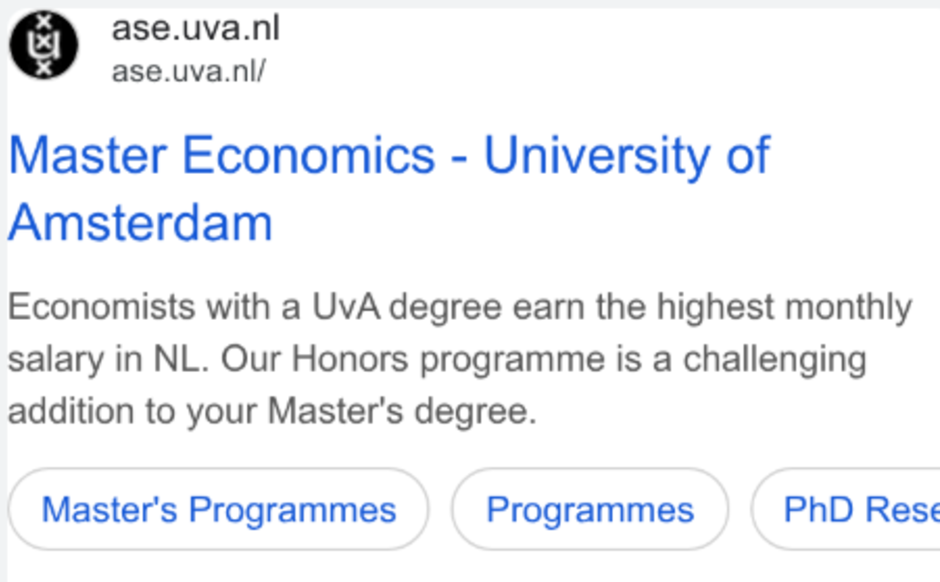
Although recruitment is permitted for “sectors with significant labor market shortages,” this does not appear to apply in all cases for these advertisements. For example, in Spain, an ad is visible for the Bachelor’s program in Economics and Business Economics. The English-language track of this program has a numerus fixus precisely to better control the number of international students.
The UvA spokesperson states that the Faculty of Economics and Business organizes various information activities, both online and on campus: “Through online campaigns, prospective students are informed about the opportunity to receive guidance during these information activities.”