Mastering the art of poetry? UvA alumna Hannah van Binsbergen teaches at Crea

The annual Poetry Week is just around the corner, this time with the theme: metamorphosis. Connoisseurs can indulge themselves starting this Thursday, but for the layperson, the main question that remains is: how do you actually write a good poem? To find out, Folia spent an evening learning from poet Hannah van Binsbergen.
Crea offers something for everyone, so it’s no surprise that lovers of the written word can also turn to the cultural centre on the Roeterseiland campus for a course. The weekly sessions – ten in total – in which participants are introduced to the fundamentals of poetry, are organised by Hannah van Binsbergen. The poet studied philosophy at the UvA, published her debut collection Kwaad Gesternte in 2016, and has been teaching at Crea for about three years.

Oldenzaal
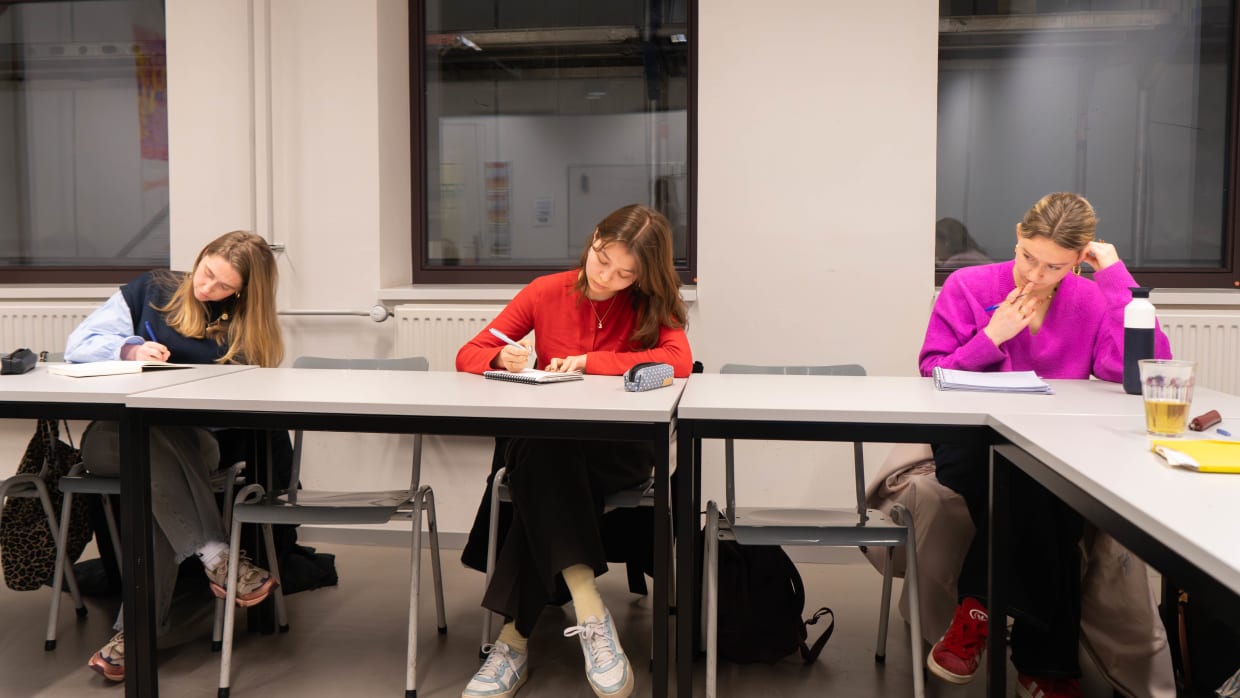
And so, this winter, just before the start of Poetry Week, a new series of lessons is on the schedule, in which a handful of Crea participants hope to awaken their inner poet. It is quarter to six when Van Binsbergen – blue shirt, checked blazer, and silver-shining buckle – opens the first evening of the course with a poem from her most recent collection, Kokanje. Pens and notepads quickly appear on the tables. On the wall of the otherwise uninspiring little room beneath the suspended ceiling hang a few poems. Beyond that, the participants have to rely entirely on their own creativity.
But that’s easier said than done, because where does a good poem actually begin? “Poetry can sometimes start with just one simple sentence,” Van Binsbergen suggests. “That one sentence that has been living in your head for a while and doesn’t seem to go away.” She gives an example: “Solidarity ends at Oldenzaal.” She chuckles. “I once read it somewhere, and it stuck with me.”
Brothers who otherwise, would never hug
fall into each other’s arms
awkward, but beautiful
and you watch
Lovers’ kisses, too long
finally melt into one another
after months of longing
and you watch
Worried grandmothers in departure halls
Balloons in the gift shop, families at La Place
CO2 emissions and missed climate targets
you watch
you watch
Inside you, the world feels different
a crowd of people, a tangle of languages
signs here, announcements there
hours in line, yet farewells so swift
the beginning and the end, woven into a complex waltz
and you watch
still today
Who speaks to whom?
But before that first line hits the page, Van Binsbergen introduces a bit of theory. The first evening of the course focuses on the question: who speaks to whom in a poem? Where does the reader stand in relation to the text and the writer? “Often, the poet isn’t addressing the reader at all, but is speaking to a distant beloved, the system, or some other abstract concept,” Van Binsbergen explains. “That means poems aren’t heard, but overheard. That distance between poet and reader makes poetry complicated, but interesting too.” In short: the straightforward approach that is common in novels, is best forgotten as soon as possible by an aspiring poet.
After a technical first hour, it’s time for some practice halfway through the lesson. “You now have fifteen minutes to write an apostrophe,” is the assignment. Nervous glances are exchanged. “And then you will present it aloud to the class.” The number of anxious faces rises, but Van Binsbergen has a tip to calm everyone down: “Don’t overthink your first line. You just need to get something on paper. You can’t edit what isn’t written down.”
Compulsory rhyme
While the participants furiously work on their texts, Van Binsbergen continues explaining the fundamentals of poetry. “Later in the course, we’ll work with elements like form, rhythm, and sound, but in the classical view of poetry, the main focus is on metre; the rhythm in which you speak, shaped by the stresses you use. In every poem, you need to think about how you use that metre. It really is the skeleton of the poem.”
Underground
Above ground, too
You rolled with your rough skin
over the hill
At first, you seemed to hesitate
Your beauty went unrecognised for a long time
A French-made suit did
become famous
But long before that, you were a muse
Picked up, gathered, you lay in a
wicker basket
Oh, everydayness
“That is why, during the course, I emphasise a hundred times that rhythm is far more important than, say, rhyme,” she continues. “Rhyme is just one of the many choices you can make with sound, but you can also perfectly well ignore it. To students who suffer from serious rhyme compulsion, I sometimes say they should try not rhyming for five lessons straight, just to show them that so much more is possible.”
Intuitive Poetry
Meanwhile, after about fifteen minutes of intense effort, the participants have finished their texts, and it’s time for the very first readings of the course. “Take it nice and slow, and read as if what you’re presenting is extremely important,” is the advice. Van Binsbergen listens patiently to the poems – which are dedicated to potatoes, airports, and job interviews – offers guidance where participants stumble, and gives compliments when impressive plays with sound and meaning are made: “By writing so intuitively in such a short time, you often make even more beautiful leaps than you realised while writing.”
She is now teaching the course for the tenth time and mainly hopes that her students, by the end of the series, have been introduced to the versatility of poetry. “If I’ve been able to show them that poetry is far more than they initially thought, I’m satisfied.”
The poems in this article were written by students during their first lesson.