This UvA company created 900 jobs through start-ups but quietly disappeared this year

In almost twenty years, the Amsterdam Centre for Entrepreneurship (ACE) supported two hundred start-ups from knowledge institutions in Amsterdam, creating nine hundred jobs. At the beginning of this year, ACE suddenly disappeared from the scene. How could this happen, and is it a problem? “With the exit of ACE, it’s back to everyone for themselves.”
“After nearly twenty years as a driving force behind academic entrepreneurship, ACE is coming to an end.” In an email to its contacts and via a post on social media, the shareholders of the Amsterdam Centre for Entrepreneurship (ACE) announced on 19 February 2025 that ACE, the first academic incubator for entrepreneurial researchers and students in Amsterdam with science-based ideas, no longer exists.
An incubator supports start-ups in the early stages of entrepreneurship. What made ACE special was that it did this with academic companies, with a focus on deep tech and science-based ideas. Think of biotechnology company Lumicks, which now employs around 170 people worldwide. Or the artificial intelligence start-up Scyfer, which was acquired a few years ago by the American company Qualcomm, one of the largest chip manufacturers in the world. In less than twenty years, ACE has supported more than two hundred start-ups, which together have attracted €170 million in investment and created 900 jobs.
Through ACE’s programmes, students and staff learned about entrepreneurship. There was also a mentoring programme, in which students and staff were paired with experienced entrepreneurs in the field to further develop their ideas.
Many of ACE’s associates were taken aback by the news. Founded in 2006 by former UvA professor Mirjam van Praag from the UvA minor in entrepreneurship, ACE was at the heart of Amsterdam’s entrepreneurial community because it was the only incubator affiliated with all of Amsterdam’s knowledge institutions: the universities, the Amsterdam University of Applied Sciences (HvA) and Amsterdam UMC. According to entrepreneurs, this is important because ACE made it easier for them to connect with other entrepreneurs in Amsterdam. What added to the shock was that shareholders seemed to be investing in the incubator with a new director.
Stanford effect
That director, Oscar Kneppers, who was appointed in March 2023, had big plans. For example, he wanted to set up an investment fund worth half a billion euros. According to Kneppers, this would ultimately create the Stanford effect. Kneppers: “People would say: I’m going to study in Amsterdam because such-and-such companies were born there. Just like Google in Stanford. And alumni with successful start-ups would also return as investors for the next generation of scientific entrepreneurs.”
All start-up initiatives in Amsterdam should also continue under one banner: Caempus, with “ae” standing for academic entrepreneurs. Each campus in Amsterdam should have several branches, clearly recognisable as the place where all academic entrepreneurs can go.

Kneppers launched that plan internally at Science Park in 2024, but then it fell through. Kneppers: “After the summer, the plan didn’t get off to a good start and it soon became clear that the shareholders’ visions were not aligned.” According to Kneppers, this was mainly due to the money for the investment fund.
For years, the shareholders had been paying ACE around half a million euros a year to keep the organisation running. At Kneppers’ request, that amount was increased to 750,000 euros a year to enable him to develop his plan. To ultimately set up the investment fund, Kneppers asks the shareholders for more than a million euros a year. “The idea was that this would buy us the time we needed to raise the 500 million euros in investment capital, after which ACE would be able to support itself and the shareholders’ contribution would become symbolic.”
Far beyond the budgets
According to Rudi Rust, director of three of the four shareholders of ACE (De Ventures Holdings of the University of Amsterdam, Amsterdam University of Applied Sciences, and Amsterdam UMC), the shareholders unanimously agreed that Kneppers’ plan was far beyond the budget they were willing to make available. Moreover, Kneppers’ plan would not offer a good solution to the challenges facing ACE.
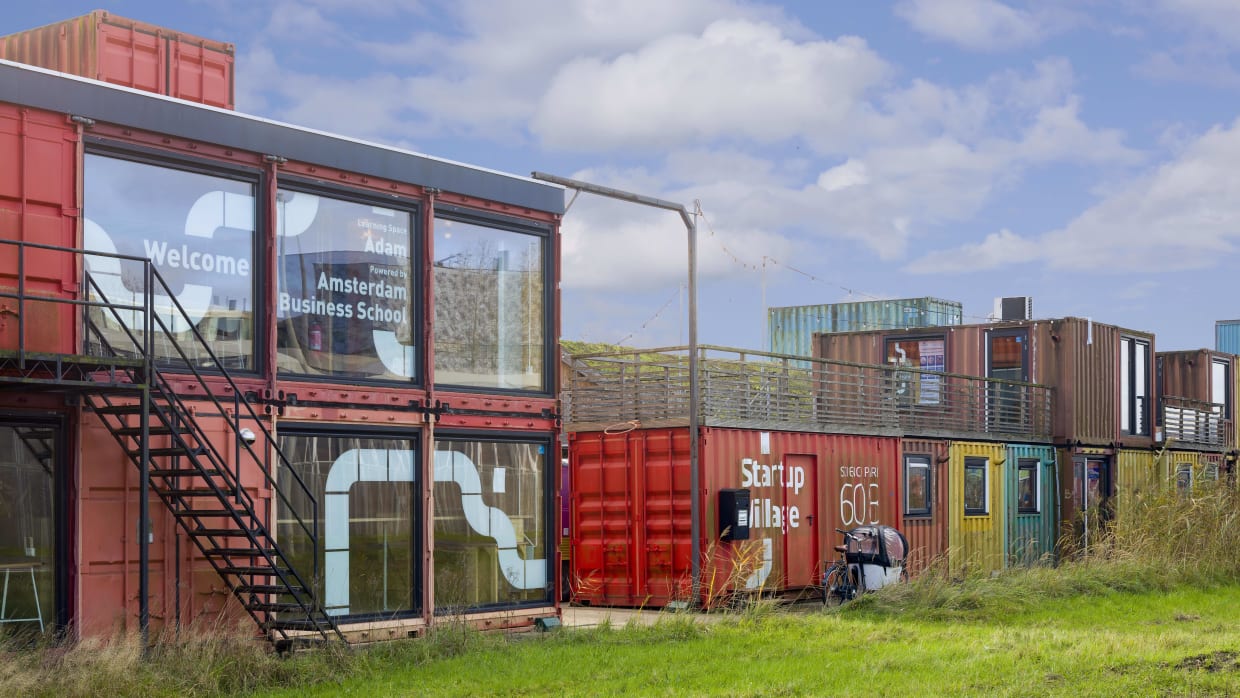
Since ACE was founded, all kinds of entrepreneurship initiatives had been launched within the universities, such as Startup Village, Demonstrator Lab, Law Hub, REC Impact, Start Hub and the Humanities Venture Lab. Rust: “They are also doing some of what ACE did.” And at the national level, competition had also emerged in the form of the Faculty of Impact and specialised incubators.
Rust: “ACE’s task was to find the right balance between quality and quantity. If ACE sets the bar low in order to help many start-ups, the best start-ups will go to selective or specialised incubators elsewhere. But if you make it too narrow, you will help few Amsterdam start-ups and compete with existing specialised incubators, such as Estec for space travel in Noordwijk. Kneppers’ plan did not offer a good solution for this. It was mainly an incubator that was going to cost a lot of money, far beyond our budgets.”
According to Rust, the reason why this will only become clear at the end of 2024 is because it was previously “not clear that it would involve so much money”. And so the plan ends up in a drawer.
Disappointed
Many people from the academic business world are surprised and disappointed by the disappearance of ACE. “From the sidelines, I noticed that the transition from ACE to Caempus didn’t really get off the ground in terms of content,” says Klaas Hernamdt, programme leader of the Humanities Venture Lab. “I think it was difficult to keep everyone on board and do something for the whole community. The decision to pull the plug did take me by surprise.”
Suzanne Hansen, Head of Partnerships in the Computational Social Science programme, is concerned about whether entrepreneurial students at the UvA will now be able to find their way. “Research shows that 3 to 5 per cent of students are entrepreneurial or already have a business. At the UvA, that would be between 1,350 and 2,250 students. Where should those students go now?”
Suzanne Hansen, Head of Partnerships in the Computational Social Science programme, is concerned about whether entrepreneurial students at the UvA will now be able to find their way. “Research shows that 3 to 5 per cent of students are entrepreneurial or already have a business. At the UvA, that would be between 1,350 and 2,250 students. Where should those students go now?”
This is also a concern for Bart Vredebregt, who founded his software start-up Aiir Innovations under the guidance of ACE. “It must be clear to entrepreneurial students where they can turn to for help. The low threshold of ACE play a key role in this.”
A gap in the entrepreneurial landscape
“The disappearance of ACE is a real disappointment,” writes Chris Slootweg, professor of circular chemistry and director of the Demonstrator Lab Science Park. “Nationally, there is the Faculty of Impact, among other things, but at Science Park there is now a gap in the lab-to-market incentive.”
The disappearance of ACE has created a gap in the entrepreneurial landscape, says Jonathan Sitruk, coordinator of the minor in entrepreneurship. “Startup Village and REC Impact have a similar function but are not yet where ACE was. What made ACE unique was that it involved all universities and higher education institutions in Amsterdam. It created a network, and that is now gone.”
Hernamdt of the Humanities Venture Lab also believes that ACE’s disappearance means the loss of an important networking function. “The important advantage of ACE was that it was a single brand for entrepreneurship in Amsterdam. Everyone in the community knew that. If I needed someone from another discipline, I would knock on their door. With the exit of ACE, it’s back to everyone for themselves. We still know each other, but the connections are naturally becoming diluted.”
Sitruk acknowledges that the entrepreneurial landscape has indeed become crowded with other initiatives. “But that doesn’t seem to me to be a reason to abolish ACE.” According to Sitruk, it is not easy to answer the question of how the gap can now be filled. “I think that if anyone had known what initiative should replace it, they would have put it in place.”
Big bang
Is an initiative that brings all academic start-up initiatives in Amsterdam under one banner too ambitious after all? Rust: “I think the honest answer is: there is no single big bang that will make that happen. I think it would only have been possible as a kind of growth model for the future. In Amsterdam, all initiatives are embedded in their own local situation with their own funding, so you can’t bring them all together under one umbrella in one go. I never say never, but in Amsterdam we’re not there yet, and we don’t have the money for it right now.”
Hernamdt is already conducting exploratory talks to strengthen cooperation between student entrepreneurship programmes in Amsterdam. “If it doesn’t come from the top, then we have to try to build something from the bottom up.”