What are those plainclothes riot police doing at UvA protests?

Plainclothes riot police, or “Romeos” showed up at both last month’s Maagdenhuis occupation and the Roeterseiland protests in 2024. What's the role of these plainclothes riot police during UvA protests? “These riot police are trained to quickly and tactically pick people out of the group.”
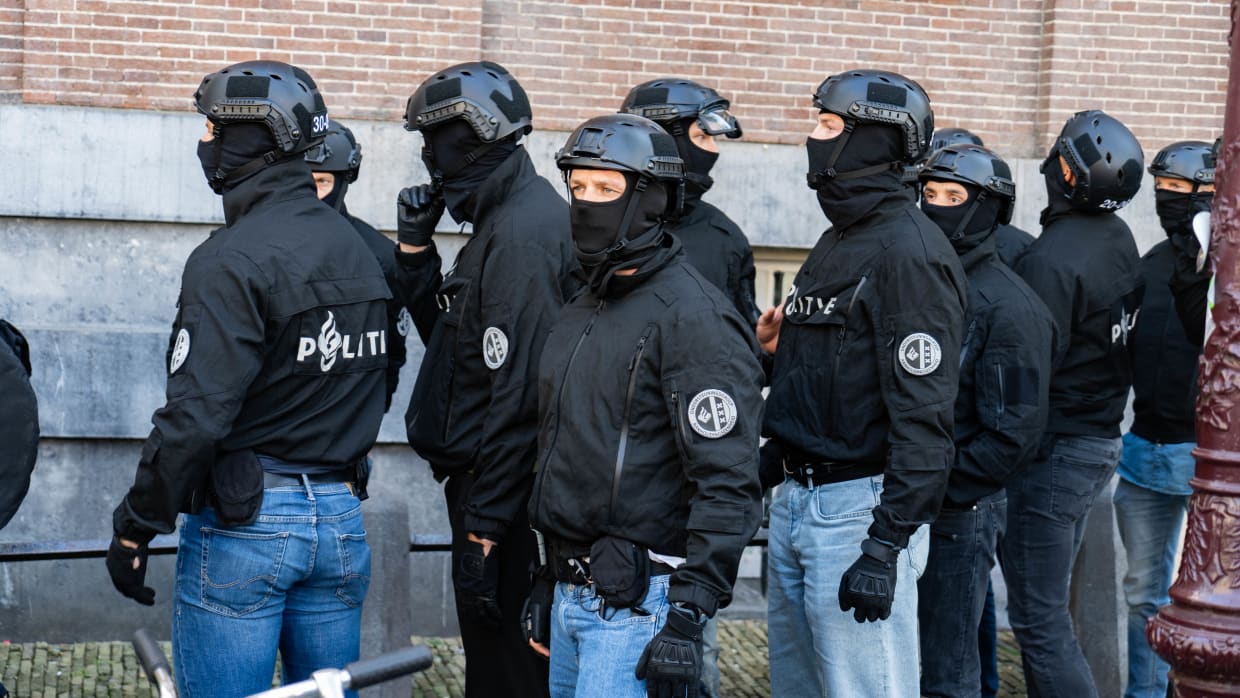
Muscular men in “normal clothing”, but carrying batons: this raised questions among people who saw videos of the Maagdenhuis protests in April on social media. Were these riot police trying to pass themselves off as students? And if so, why were they carrying weapons?
According to Timmer, under Article 7 of the Police Act, an officer may use force to carry out his duties, provided that it is proportionate and a warning has been made in advance, unless the situation is too dangerous.
Protesters and the media testify that during the Maagdenhuis protest, the citizen riot police used violence without prior warning. The police spokesperson denies this and reports that the officers “repeatedly ordered the door to be opened,” according to Het Parool.
In addition, Amnesty International NL, the media and seventy UvA employees criticized what they considered to be “disproportionate police violence” used by the civilian riot police during the Maagdenhuis protest. The police say they are currently “investigating the context” of this violence.
Based on his analysis of the footage, Sunde argues that the civilian riot police had “clear control over the situation” and probably did not need to use violence, but could have physically removed the protesters, as recommended by Amnesty International NL. He warns that the use of a baton is “much more strongly correlated with injuries” than other non-lethal weapons, such as pepper spray. Timmer argues that the use of pepper spray inside a building is not an option.
According to Timmer, officers who have used violence must always report this internally afterwards. He therefore advises demonstrators who are injured by police violence to file a complaint or report it to the police.
These men are known as “Romeos”: officers who go plainclothed during UvA protests to pull students out of the crowd and arrest them. Although these riot police officers like to move inconspicuously among groups of UvA protesters, they are quickly recognized by some. “They are very muscular and always wear the same jeans,” says Wouter*, who was present as a protester at the Maagdenhuis protest. However, Het Parool reported that it was not clear to all protesters that they were police officers.
These civilian riot police officers have since been spotted by protesters and journalists at both the Roeterseiland protests in May last year and during the Maagdenhuis protest last April. So who exactly are these alleged “undercover agents”?
Romeos in the crowd
According to Jaap Timmer, a police scientist at VU University Amsterdam, these riot police officers are educated and trained to “quickly and tactically pick people out of the group.” “They belong to the riot police arrest unit, a group of eight people with a commander. They often have specific individuals in mind whom they pick out of the crowd to arrest.” Those who are isolated from the crowd are the demonstrators whom the police consider to be instigators of criminal acts, Timmer explains. “The troublemakers and agitators in the group”.
This role explains why these riot police officers wear jeans and not protective gear such as shields and helmets, says Timmer. “In order to blend in with the crowd, they don’t want to look recognizable. That’s why they don’t usually wear uniforms.”
Not undercover agents
Nevertheless, they are not undercover agents, Timmer emphasizes.“Going ‘undercover’ is something completely different: those are covert operations, often involving serious and organized crime. The ME doesn't even come close to that.” Nor are they an elite unit, because working as a riot police officer is a secondary function, Timmer continues. “They are just regular police officers, working on the streets, for example.”
Interaction images
Although they are not undercover agents, the question remains as to what effect their outfit has on UvA protesters.
Criminologist Hans Myhre Sunde, who recently obtained his PhD at the UvA on how officers unfold, escalate, or de-escalate interactions, analyzed footage (video 1 en video 2) of riot police in plain clothes at the Maagdenhuis protest for Folia. “It was a truly exceptional situation, certainly compared to the everyday interactions between citizens and the police that I studied for my research.” For his research, he studied more than a thousand hours of camera footage from Amsterdam and participated in studies on contact between citizens and the police during the Covid-19 riots in 2021.
Effect of clothing
He says that the clothing worn by the police officers may have had an effect on the behavior of the mostly young UvA protesters. “Some studies show that young people say they have more trust in the police when officers wear uniforms. They are seen as more legitimate than when they are in plain clothes.”
At the same time, he emphasizes that a riot police officer with a shield and helmet actually “inspires less confidence” than someone not wearing a riot uniform. According to Sunde, it is “difficult to say with certainty whether a police uniform would have been better than plain clothes in the situation shown in the videos”. Personally, he tends to favor a uniform. “People might get startled by plainclothes officers before they realize after a few seconds that they are police. With a uniform, it's easier to see.”
Batons
Sunde also looked at the behavior of the riot police and the protesters in the footage. He emphasizes that it is difficult to make a clear judgment about this. “The protesters felt they had the right to demonstrate, while the officers had a legitimate duty to remove them from the building. So these were two highly motivated groups with completely different beliefs, for whom these situations will always remain difficult.”
Nevertheless, he does have one comment about one of the videos. It shows plainclothes riot police running onto the Binnengasthuis site with their batons at the ready. He understands that the police may have done this in the hope of ending the demonstration quickly. “But many studies show that this approach is not very effective in de-escalating situations and is likely to be counterproductive in building trust and legitimacy between the groups.”
Communication problems
In addition, Sunde notes that communication problems may have played a role during the citizen ME’s actions. He points out that in the video in which the citizen ME members chase protesters out of the building, the officers can be heard giving orders in Dutch while the protesters speak English. “This may indicate a language barrier.” According to Wouter, there was indeed confusion among the protesters about the police orders. “Those officers kept shouting ‘run’ and ‘get out of the building,’ while it was unclear to us where the exit was.”
According to Sunde, such misunderstandings between the police and citizens can lead to “a breakdown in communication, which is one of the scientifically known ‘routes’ to escalation of violence.”
Criticism works council FdG
According to the Faculty of Humanities’ works council, the lack of communication with protesters – with riot police already close to or at the site of the demonstration or occupation before the UvA reported the incident – led to the deployment of civilian riot police during the Maagdenhuis protest, which would be contrary to the recommendations of the evaluation report on the May 2024 protests.
Sunde says that early talks between protesters and the police can help prevent de-escalation. “By deploying protesters as liaisons to form a communication bridge between the police and protesters, you can partially break the ‘path’ to escalation, provided this happens in the first two hours of the protest. After that, people get tired, and that’s often when things go wrong.”
It is difficult to predict in advance whether plainclothes riot police will be deployed again at future protests. Sunde hopes it will not come to that. “In my view, deploying such officers in protests should be the very last option when all other possibilities have been exhausted.”
*Wouter’s full name is known to the editors.