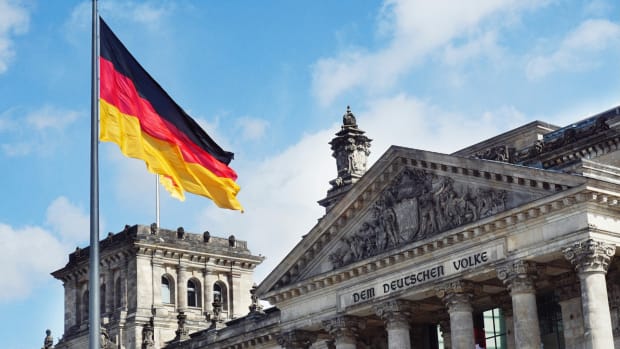
German elections | What can we expect on Sunday?

The meddling of Elon Musk and J.D. Vance, attacks, and the rise of the radical-right AfD: this Sunday’s German parliamentary elections seem more exciting than ever before. What can we expect from the Bundestagswahl 2025 on Sunday? Historian and researcher Hanco Jürgens, lecturer at the Duitsland Instituut, responds to five questions.
How are these elections being viewed in Germany?
“I think Germany is undergoing a kind of shock therapy because so many things are currently happening at the same time, that are changing the country's position. At first it was mainly about the poor state of the economy, but then the attacks in Munich and Magdeburg came on top of that. The way Friedrich Merz reacted to that is also striking. He wants to take a number of harsh measures by sending illegal migrants back at the border and detaining undocumented people. This was only possible with the support of the radical right-wing AfD. So I think that many German voters have had a wake-up call this past month, and it is now very clear that a new cabinet will have to provide an answer to all these issues.”
Experts are calling the elections “more exciting than ever.” Is that true?
“Actually, it is not that bad. An incredible amount has happened in the past month, but the polls remain very stable. That could mean that many Germans have already made up their minds. This has created a fairly predictable picture in which the CDU is set to become the largest party by far, with the AfD in second place, followed by the SPD and Die Grünen.”
“The biggest question is whether it will be a two- or three-party government, which depends on the smaller parties. If smaller parties such as the FDP fail to reach the electoral threshold, their remaining seats will be divided among the larger parties. If that happens, the intended coalition parties, the CDU and SPD, could win enough seats to govern together. If that does not happen, Die Grünen would have to join, which would result in a strongly divided left and right bloc in one cabinet. That would be difficult for the government's stability because it would lead to arguments. Moreover, in that case the AfD would point out that CDU voters would have to make concessions once again, and that you would therefore have to vote for the AfD for a truly strict asylum policy. That would lead to all kinds of new political unrest.”
Is the rise of the AfD the most important factor in these elections?
“For many Germans, maintaining the cordon sanitaire towards the AfD is essential. This can all be explained by the Second World War and the fragile Weimar democracy, which was destroyed by the National Socialists in 1933 in 54 days. That is much more sensitive there than it is here. If the CDU were to collaborate with the AfD, they would lose many members and the party would split in two. The AfD does not believe this is a realistic scenario. They predict that the Brandmauer – the German cordon sanitaire within which there will be no cooperation with the AfD – will be maintained, and the CDU will veer to the left, creating even more space for the AfD.”
“However, I certainly would not want to talk about a normalisation of the AfD. When the CDU introduced a motion a few weeks ago that could only go ahead with the support of the AfD, hundreds of thousands of people took to the streets in Berlin and Munich to demonstrate against it.”
What do these elections mean for science in Germany and Europe?
“You can see that a number of issues, such as the climate, are less prominent. And when it comes to how much money should be spent on innovation, that has not been fully determined yet. According to Draghi’s report, Europe must spend much more on knowledge and innovation, but Merz of the CDU has more or less rejected that idea as it is too expensive. So the question is whether science will not be compromised given all the other necessary expenses, with defence naturally standing out.”
“It could well be less than under Angela Merkel, when science was given an awful lot of money and space. Still, it is part of the German self-image to be involved in innovation and technical renewal, so I suspect that the focus on science will still be quite large.”
If the polls are right, what will the consequences be for the Netherlands?
“I do not think it will be unfavourable for the Netherlands because ideologically the CDU government is close to the Dutch centre-right government. Moreover, the CDU has traditionally always had a keen eye for its small neighbouring countries. Merz also comes from that tradition. He is from Westphalia, close to the Netherlands, and is also fairly in line with parties such as the VVD and NSC when it comes to Ukraine policy.”